The 61st Annual Institute of the American Classical League has come and gone and I sit to write about it from the other side of a short family vacation to Long Island. The University of New Hampshire in Durham played an outstanding host and Sherwin Little, Tom Sienkewicz, Geri Dutra, and all others involved in the planning and execution of this outstanding gathering are to be commended.
I took the slow and liesurely route and drove to the Institute from Virginia. I set out on Tuesday morning and reached my goal of getting past most of the New York metropolitan area about mid-afternoon. In all, not a difficult drive but getting across the George Washington Bridge and navigating through the Bronx amid a sea of tractor-trailers was a bit of a pain. The next morning I easily completed the trip to New Hampshire and spent the night in Dover, about five miles outside of Durham. I stayed in Dover because, alas, there was no room in the inn at Durham when I made arrangements for lodging. The next day I move my belongings to the Holiday Inn Select at Durham and settled in for the Institute. On my return trip, getting past the traffic and bother of New York City was again my goal and I spent the night at East Windsor, New Jersey (near Princeton) via the Massachusetts Turnpike and a scenic trip through the Berkshires.
Anyhow, back to the Institute. Here are some highlights: My first interest involved Advanced Placement Latin and the College Board... Too much time was spent at the first session involving the grading of this year's exams with the presenters talking about how they had nothing to do with the decision about cancelling the AP Latin Lit exam and how we all must be calm and reasonable. No problem there. The later plenary session, titled "Latin Advanced Placement Tests: Responses and New Directions?", promised to be more interesting but I left disappointed and feeling no better (and no more informed) about the entire situation. No one was present who had actually had some say in the decision, just those who had something to say. Primarily, and I find this impressive after the initial reaction on LatinTeach and elsewhere, there were no fireworks, yelling, screaming, or crying. Everyone remained civil. We were assured that the Vergil exam would not change (probably) for the next three years or so and that we all, teachers, professors, professional organizations, would have input into future changes. I don't know how this was promised when there were no "officials" present. Most of the comments and suggestions were interesting and reasonable but there was nothing new or even reassuring that we had regained control of what and how we teach on the upper levels (if, indeed, we ever had control). I was annoyed at the presenter from a very prestigious prep school who suggested that we really don't need the AP exam. His school had dropped the entire AP program several years earlier and, guess what, their students continued to have no problem getting into Harvard, Yale, and Princeton. Um, when your prestigious prep school carries instant name recognition, it is true that AP results make no difference in the admissions offices, BUT your average high school in your average town across the country has to buy into the AP program in order to level the playing field just a bit for their students. Like I said, I did not leave the plenary feeling better about things.
I was very interested by Matthew Hartnett's presentation on "Inscriptions and Graffiti in the Latin Classroom" and I intend to bring this genre of authentic Latin into my classes as soon as possible. Just because it isn't great literature doesn't mean it isn't interesting and has value in the classroom.
Ken Kitchell's "Teaching Latin Comp the Fun Way - The Long and the Short of It" was thoroughly enjoyable. It was refreshing (and a little reassuring) to learn that colleges and universities assign creative projects for their students and they end up having a great time while learning.
I was the presider for "Latin Via Storytelling: Backwards Design to Fit Any Textbook" and this session may well prove the most useful for me. Bob Patrick, Stephanie Sylvester, and Rachel Ash did an outstanding job of presenting the techniques and benefits of TPRS in the Latin classroom. The almost painless method of teaching and learning new vocabulary is alone worth consideration of this method. I need to apply some more thought here.
More than anything else, the benefit and purpose of attending an ACL Institute are the opportunities to meet new teachers and reconnect with old fiends and acquaintances. Putting a face with a name only seen on LatinTeach is great. It is very important that a professional establish contacts and networks in order for ideas, help, and suggestions to flow freely. No one can teach on an island and expect to grow.
Finally, there was the clambake. Not being a fan of seafood, I must admit that I opted for the barbequed chicken. I know that I wimped out but I have never found seafood to be palatable (and to think that I live so close to the Chesapeake Bay!). I did enjoy the company of my colleagues who were enjoying their lobsters and clams, though, and that's the best thing!
Next year in LA? We'll see!
Wednesday, July 09, 2008


Tuesday, July 08, 2008
Returning to the Task at Hand
I have been ignoring this blog for way too long. It is time to get back to writing and putting down into words my thoughts and ideas about Latin, the ancient world, and teaching.
Tuesday, March 04, 2008
Riding Those Ponies
In this day of quick and easy answers from the internet, it is too easy for our students to give in to the expedient and avoid the honorable. I have seen students take a question and make a bee-line for Wikipedia and not really read the article but scan it and hit the print button. They will read the copy later. On top of that, they also make multiple copies and distribute them to their classmates. They too will read the copies later. I have seen Latin students (gasp!) Google a poem of Catullus, make copies, and pass them around. No problem, though, their homework is done and they can move on to more important things.
O tempora! O mores! What would Cato say? What would Cicero think? What would Quintilian do?
The answer lies in what we expect from our students. They have ready access to all the answers and this resource is not going away. We as teachers need to refocus our efforts and teach our charges how to handle and understand all these answers. What is a good answer and what is bad? Why? How can one tell the difference?
Unfortunately the machines are now the vessels of knowledge. The belief among the students are that there is no longer a need to learn and memorize, regardless of the need to spout forth these seemingly random facts on the so-called high stakes test du jour.
I tell my students that they need to learn how to think, how to analyze, and how to understand what is being said by the author we are reading. If they take the easy path and print out someone else's translation, they are, in fact, defeating the purpose for being in the class. Anyone can read off from someone else's efforts and feel satisfied... but to what end?
More thoughts later -- I think I'm just rambling here.
O tempora! O mores! What would Cato say? What would Cicero think? What would Quintilian do?
The answer lies in what we expect from our students. They have ready access to all the answers and this resource is not going away. We as teachers need to refocus our efforts and teach our charges how to handle and understand all these answers. What is a good answer and what is bad? Why? How can one tell the difference?
Unfortunately the machines are now the vessels of knowledge. The belief among the students are that there is no longer a need to learn and memorize, regardless of the need to spout forth these seemingly random facts on the so-called high stakes test du jour.
I tell my students that they need to learn how to think, how to analyze, and how to understand what is being said by the author we are reading. If they take the easy path and print out someone else's translation, they are, in fact, defeating the purpose for being in the class. Anyone can read off from someone else's efforts and feel satisfied... but to what end?
More thoughts later -- I think I'm just rambling here.
Tuesday, February 19, 2008
O Fortunate Rock
In my Latin III classes we are translating O Fortuna from the Carmina Burana. The Latin is not difficult and the students enjoy honing their skills on something short and sweet. What made the class sweeter was playing the music to this poem and seeing my students' eyes light up as they immediately recognized the tune. I asked them where they had heard this music before and they offered several movies and commercials... one girl even suggested The Lion King.
I then played the rock version of O Fortuna by a band called Therion and I had them hooked. If you haven't heard this version before, go to iTunes and give it a listen... it is truly impressive and will replay over and over in your head.
There's something to be said when the Latin students leave the room and saunter down the hall whistling or humming the music from O Fortuna!
I then played the rock version of O Fortuna by a band called Therion and I had them hooked. If you haven't heard this version before, go to iTunes and give it a listen... it is truly impressive and will replay over and over in your head.
There's something to be said when the Latin students leave the room and saunter down the hall whistling or humming the music from O Fortuna!
A Rosetta Stone on the Acropolis

Archaeologists have unearthed a stone on the Acropolis in both Greek and Latin! :)
My daughter took this photograph in June 2007.
Monday, February 18, 2008
Ha! So Much for Therapy!
It is Presidents' Day, February 18, and I am making my first post since August. I had said posting to my blog would be therapy for seven classes with five preps, department duties, Latin Club, certamen, and other outside professional responsibilities... Who has time for therapy?
The year has been very busy (as you would expect) and time just slips away. I can barely keep all my classes up to speed and sometimes that doesn't even happen. I often describe myself as a juggler. I have so many balls to juggle, though, that it takes all my talent just to keep them in the air -- don't expect me to do anything fancy with them. And, yes, sometimes I drop one or two and they may lie on the floor for a little while, but I snatch them up and toss them back into the air.
I really do want to get back to my blogging.
The year has been very busy (as you would expect) and time just slips away. I can barely keep all my classes up to speed and sometimes that doesn't even happen. I often describe myself as a juggler. I have so many balls to juggle, though, that it takes all my talent just to keep them in the air -- don't expect me to do anything fancy with them. And, yes, sometimes I drop one or two and they may lie on the floor for a little while, but I snatch them up and toss them back into the air.
I really do want to get back to my blogging.
Monday, August 20, 2007
The Wheel in the Sky
I was listening to the local classic rock station driving to the first teacher workday this morning and when I turned onto the street on which the school is located, I heard these lyrics:
Oh, the wheel in the sky keeps on turning
Ooh, I don`t know where I`ll be tomorrow
Wheel in the sky keeps me yearning
Ooh, I don`t know, I don`t know
This song by Journey is not perhaps the most appropriate song (Google the lyrics) but the first line which Steve Perry kept singing was fitting. Each year is a new beginning. The graduating seniors have been replaced by the eager, tentative, incoming freshmen, and the retiring teachers have been replaced by eager, tentative, incoming rookies. Everyone gets a new, fresh start and the wheels keep on turning.
Sunday, August 19, 2007
Here We Go Again!
It is the evening before veteran teachers are to report to school. The rookies have already spent three days in training camp. The supplies have been ordered. The floors are waxed. There's no doubt that a new school year is about to begin.
I look back at my summer with mixed results. I am a bit surprised because I am not even sure that summers are supposed to have results. I had grand plans of revamping all my classes and having all these amazing handouts and presentations ready to go. Ha-ha... no. There's no great disappointment, though, because things can always be revamped as we go, and that's probably better pedagogy because any revision will fit the students in their present situation, not in some pie-in-the-sky, administrative expectation.
I am embarking on my 21st year of teaching and, guess what, I'm still trying to figure it all out. If any teacher tells you they have all the answers and know exactly how things work, look at them askance, make up some excuse that you left your first day handouts on the copier machine, and move away. You may need to smile and nod, but that usually covers the requisite response.
I am planning to post more this year, if, for nothing else, as a means of therapy. For the first time in many, many years, I am the only Latin teacher in the building and will be teaching all five levels: Latin I, Latin II, Latin III, Latin IV, and AP Latin Literature (Catullus & Ovid). Add to this mix an active Latin Club, competitive certamen teams, and a bunch of other professional responsibilities. My wife is the head teacher-librarian (NBCT!) where I teach, my daughter will be entering the same high school (and having me as a Latin teacher) and my son will be in his last year of elementary school. They all have active schedules and life for the next 10 months or so is looking to be quite hectic. Therapy will be a necessity!
I look back at my summer with mixed results. I am a bit surprised because I am not even sure that summers are supposed to have results. I had grand plans of revamping all my classes and having all these amazing handouts and presentations ready to go. Ha-ha... no. There's no great disappointment, though, because things can always be revamped as we go, and that's probably better pedagogy because any revision will fit the students in their present situation, not in some pie-in-the-sky, administrative expectation.
I am embarking on my 21st year of teaching and, guess what, I'm still trying to figure it all out. If any teacher tells you they have all the answers and know exactly how things work, look at them askance, make up some excuse that you left your first day handouts on the copier machine, and move away. You may need to smile and nod, but that usually covers the requisite response.
I am planning to post more this year, if, for nothing else, as a means of therapy. For the first time in many, many years, I am the only Latin teacher in the building and will be teaching all five levels: Latin I, Latin II, Latin III, Latin IV, and AP Latin Literature (Catullus & Ovid). Add to this mix an active Latin Club, competitive certamen teams, and a bunch of other professional responsibilities. My wife is the head teacher-librarian (NBCT!) where I teach, my daughter will be entering the same high school (and having me as a Latin teacher) and my son will be in his last year of elementary school. They all have active schedules and life for the next 10 months or so is looking to be quite hectic. Therapy will be a necessity!
Thursday, July 26, 2007
Crossing the Rubicon with a Ham and Cheese on Rye
I was making my way to the grocery store the other day and noticed that the construction at the community church across the street was almost complete. During the building I was impressed that the church was making such a large addition - more than doubling its space - and then learned how they were going to use their extra rooms. One wing is labeled "Education Center" and the other "Rubicon Cafe." I had to take another look as I left the grocery store to make sure I was reading it correctly. The church is very popular and has grown tremendously in the past few years since it has opened. It is nice to see them expanding their offerings.
When Julius Caesar reached the Rubicon River back in 49 BC, he had to make the decision whether to cross this boundary into Italy Proper at the head of his troops and, thus, essentially declare civil war on Rome. He crossed the Rubicon, declaring "Alea iacta est!" ("The die is cast!"), and passed the point of no return. He had made his move.
Now, a church calling its public cafe "Rubicon" is making quite a statement. It certainly adds a lot of pressure for someone who stops in for a ham and cheese on rye.
When Julius Caesar reached the Rubicon River back in 49 BC, he had to make the decision whether to cross this boundary into Italy Proper at the head of his troops and, thus, essentially declare civil war on Rome. He crossed the Rubicon, declaring "Alea iacta est!" ("The die is cast!"), and passed the point of no return. He had made his move.
Now, a church calling its public cafe "Rubicon" is making quite a statement. It certainly adds a lot of pressure for someone who stops in for a ham and cheese on rye.
Sunday, July 22, 2007
Authors as Prophets
On the day when the world was tearing into J.K. Rowling's seventh and final book in the wildly successful series about the boy-wizard Harry Potter and his fight against evil, I must admit that I, at last, picked up her first book, Harry Potter and the Sorceror's Stone. I am familiar with the characters, the plot, most details of the story, and (being the parent of a 14- and 10-year-old) have seen all the movies multiple times. I discussed the seventh book with my wife and daughter who finished the tome the very same evening they waited in line to get their copies. Now that I know how the story ends, I am reading all the works with an eye to how the author develops her story and seek to tie up the loose ends as I come across them. I am still enjoying the story and expect to learn, first-hand, many more details of the story.
Early in the first book (toward the end of the first chapter), I was struck by a passage in which Professor McGonagall claims, "[Harry Potter will] be famous -- a legend -- I wouldn't be surprised if today was known as Harry Potter day in the future -- there will be books written about Harry -- every child in the world will know his name!" When Rowling was writing this first book, surely she didn't believe that her books would be so wildly successful. She could certainly hope so, but hindsight now proves her prophetic statement to be amazingly correct!
Immediately I thought of Latin authors who had made similar prophetic statements in their own works. Ovid writes, Mantua Vergilio, gaudet Verona Catullo;/ Paelignae dicar gloria gentis ego (Mantua rejoices in Vergil, Verona in Catullus; I shall be called the glory of the Pelignian race)(Amores III.15, ll. 7-8). Of course Ovid is writing after he has accumulated some fame but he has no doubts that he will be famous and deserves (rightly so) to be included in the same club with Vergil and Catullus. Further, Martial writes toto notus in orbe Martialis/ argutis epigrammaton libellis ([I am] Martial, known around the world for his clever little books of epigrams)(Epigrams I.1, ll. 2-3). He, also having already attained fame, has correctly predicted the future. Finally, there is the famous Latin quote which immediately came to mind as soon as I read Rowling's words, Non omnis moriar multaque pars mei/vitabit Libitinam; usque ego postera/crescam laude recens, dum Capitolium/ scandet cum tacita virgine pontifex. (I shall not entirely die and a big part of me will avoid Death; I will continue to grow fresh with following praise as long as the pontifex climbs the Capitoline with the silent virgin.)(Horace, Odes III.30, ll. 6-9). Horace is confident in his permanent place in literary history. He, too, though, writes with the knowledge that he is already a great poet. What did Rowling know of her coming fame and prosperity? Will her works become classics and be read many, many years from now? She (and we) really have no way to tell. Her legacy will assuredly rest in bringing countless people, including school children distracted by so many things outside of formal education, to opening a book and (obsessively) devouring it's words.
As a side note, I pondered Horace's words and realized how true his prediction still is. He said that he will continue to live, and subsequently be read, as long as the Pontifex climbs the Capitol accompanied by the silent Virgin. A different Pontifex (the Pope) still climbs a hill (the Vatican which is the Capitol of the Catholic Church) accompanied by the silent Virgin (Mary, the Mother of Christ).
Early in the first book (toward the end of the first chapter), I was struck by a passage in which Professor McGonagall claims, "[Harry Potter will] be famous -- a legend -- I wouldn't be surprised if today was known as Harry Potter day in the future -- there will be books written about Harry -- every child in the world will know his name!" When Rowling was writing this first book, surely she didn't believe that her books would be so wildly successful. She could certainly hope so, but hindsight now proves her prophetic statement to be amazingly correct!
Immediately I thought of Latin authors who had made similar prophetic statements in their own works. Ovid writes, Mantua Vergilio, gaudet Verona Catullo;/ Paelignae dicar gloria gentis ego (Mantua rejoices in Vergil, Verona in Catullus; I shall be called the glory of the Pelignian race)(Amores III.15, ll. 7-8). Of course Ovid is writing after he has accumulated some fame but he has no doubts that he will be famous and deserves (rightly so) to be included in the same club with Vergil and Catullus. Further, Martial writes toto notus in orbe Martialis/ argutis epigrammaton libellis ([I am] Martial, known around the world for his clever little books of epigrams)(Epigrams I.1, ll. 2-3). He, also having already attained fame, has correctly predicted the future. Finally, there is the famous Latin quote which immediately came to mind as soon as I read Rowling's words, Non omnis moriar multaque pars mei/vitabit Libitinam; usque ego postera/crescam laude recens, dum Capitolium/ scandet cum tacita virgine pontifex. (I shall not entirely die and a big part of me will avoid Death; I will continue to grow fresh with following praise as long as the pontifex climbs the Capitoline with the silent virgin.)(Horace, Odes III.30, ll. 6-9). Horace is confident in his permanent place in literary history. He, too, though, writes with the knowledge that he is already a great poet. What did Rowling know of her coming fame and prosperity? Will her works become classics and be read many, many years from now? She (and we) really have no way to tell. Her legacy will assuredly rest in bringing countless people, including school children distracted by so many things outside of formal education, to opening a book and (obsessively) devouring it's words.
As a side note, I pondered Horace's words and realized how true his prediction still is. He said that he will continue to live, and subsequently be read, as long as the Pontifex climbs the Capitol accompanied by the silent Virgin. A different Pontifex (the Pope) still climbs a hill (the Vatican which is the Capitol of the Catholic Church) accompanied by the silent Virgin (Mary, the Mother of Christ).
Monday, July 16, 2007
Back to Basics
At the end of the school year I learned that I will be teaching Latin I this fall. Most teachers would not find this assignment surprising but I am a tiny bit nervous and becoming increasingly excited because I have not taught Latin I for well over a decade... maybe since 1994! I have taught Latin II, III, IV, V, AP Vergil, and AP Latin Literature, but the Latin I classes have always been covered by teachers who floated between schools.
This new addition to my teaching assignment provides me with the opportunity to apply those techniques and ideas which have been discussed and presented at numerous workshops, institutes, and on the LatinTeach list. Such things include oral Latin and pronunciation, emphasis on reading and not simply translation, and integration of culture, history, and mythology into the Latin (Why can't the questions and/or answers about these subject areas be in Latin?).
I have long inherited students who have adopted the philosophies, techniques, interests, and abilities of their Latin I teachers. Some of these teachers have been experienced, others fresh off the vine. I took their students and moved them forward from where they were dropped off. Sometimes I could make adjustments, sometimes not.
Now is the time for me to put up or shut up. I will be taking a group of students and teaching them from the very beginning. It will be an exciting ride... stay tuned!
This new addition to my teaching assignment provides me with the opportunity to apply those techniques and ideas which have been discussed and presented at numerous workshops, institutes, and on the LatinTeach list. Such things include oral Latin and pronunciation, emphasis on reading and not simply translation, and integration of culture, history, and mythology into the Latin (Why can't the questions and/or answers about these subject areas be in Latin?).
I have long inherited students who have adopted the philosophies, techniques, interests, and abilities of their Latin I teachers. Some of these teachers have been experienced, others fresh off the vine. I took their students and moved them forward from where they were dropped off. Sometimes I could make adjustments, sometimes not.
Now is the time for me to put up or shut up. I will be taking a group of students and teaching them from the very beginning. It will be an exciting ride... stay tuned!
Thursday, July 05, 2007
Making Connections II: Paying It Forward

On a recent trip to Italy and Greece I called a student over to my table after dinner and invited her to sit down. I told her I had something for her to think about. Just that day we had visited the Sistine Chapel in the Vatican City and I came upon this student standing in the middle of the floor, slowly turning her head. Her jaw had dropped and her eyes were wide open. This place, this moment, had made her trip. Everything else we would see afterwards would be fluff, second-rate -- exciting, but not as moving as Michelangelo's magnificent ceiling. This student had just graduated from high school where she had participated in four years of a very rigorous and demanding gifted program. She is also an artist and used this outstanding talent as a creative outlet. She will continue her education in the fall at the College of William & Mary, taking anything and everything but reserving space in her schedule for art and art history. Now, back to dinner. I told my student that this year was the 25th anniversary of my first trip to Rome and that I had come as a student, just having graduated from high school, with my Latin teacher. I told her that she needed to give consideration to bringing her own art students to Italy in the future and give some student the same experience my Latin teacher had given me and which I had just given her. I asked her to pay it forward. She said that she would...
Making Connections I

I know that I have posted an image of an umbrella pine tree before... but today I have a reason!
My students and I recently returned from a trip to Italy and Greece and I have a proud-teacher moment I have to share. We had just passed through the Porta Marina and into Pompeii when our local guide herded us into the shade and began his spiel about the city and the eruption of Mount Vesuvius which buried the site in AD 79. The guide went into great detail to describe the eruption and likened the cloud which rose from the mountain to a mushroom or a nuclear blast. One of my students bravely raised her hand and commented, "Pliny the Younger described the cloud as an umbrella pine tree." The guide paused a moment and replied, "Yes! Yes, indeed! You are quite correct!" and, with no umbrella pines in sight, described the tree for the rest of our group. Seemingly impressed that there were students who knew who Pliny the Younger was and had even translated the letter from Latin, he continued to make reference to the letter as our tour continued.
For the rest of the tour that afternoon, I was the one who was beaming with pride that my student had referenced material we had covered in the classroom and used it to make a visit to Pompeii more meaningful.
- Footnote 1: When you take a group to Pompeii, ask for Eugenio/Eugene or Mimo. Both of these local guides are outstanding and will try to accomodate requests.
- Footnote 2: If you have extra time in the schedule and the weather is cooperating, ask for more time after the organized tour to allow students to take more pictures or visit sites not normally on the tour, e.g., the amphitheater, gladiators' barracks, palaestra, etc.
Sunday, April 01, 2007
Monumentum Amphitheatri Flaviani Nocte Visum
 The Flavian Amphitheater at night...a much more peaceful place than during the day. This photograph was taken by the husband of a colleague during our trip in July 2005.
Saturday, March 31, 2007
Culpa
I began class the other day by reviewing (very briefly) the indirect command and then asking for a quick outline of the story we were translating before picking up in the middle and moving forward. I was met with blank stares. I asked again, even calling upon some students by name. I was becoming frustrated and could feel my blood-pressure rising; I was thinking that no one in the class had bothered to do the assignment. Then I looked down at my lesson plans and realized that I had not even introduced the indirect command to them and they had not been assigned the translation... we had not even begun the translation! I paused. I smiled. I laughed. And then I told them to never mind -- that was the other class' assignment. Some looked relieved, some smiled, others looked annoyed (but that's OK, they look annoyed most of the time). I teach on the alternating day (A-B) block scheduling system and had confused my "A" day class with my "B" which was a couple days ahead.
I have made mistakes in the classroom before. I can remember introducing a topic once (I forget what it was) and, although not bothering to review my notes ahead of time, presented it to my students with great confidence and flourish. I scribbled away on the board and they dutifully took the notes. Then I told them to open up their books and look at some examples for practice. I was horrified (internally) to discover that what I had spent the last fifteen minutes or so explaining was wrong... very wrong. I paused. I smiled. I laughed. And then I told them to never mind, "Please take the notes you just wrote, rip them out of your notebook, and throw them away!" I even picked up the trash can and carried it desk to desk so that they could throw their notes away. I explained that, yes, even I made mistakes and that I had just made a big one. I then took a bow and said, "Let's start again."
In my twenty years of teaching, I have made numerous mistakes. I humbly express my mea culpas and move forward. Students need to see that teachers make mistakes, but, even more importantly, they need to see their teachers admitting them and correcting them. Some of what we teach in the classroom has little to do with the subject matter described in the course catalog. None of us is perfect and none of us should lead our students to believe that we are. Part of learning language is making mistakes and having those mistakes corrected and, thus, providing experiences to build on.
I remember early one morning in Rome. I awoke and slipped out of the hotel before my students were to meet downstairs for breakfast. I went to the cafe next door and confidently ordered, "Uno cappuccino, per favore." I had been practicing the phrase all the way to the counter because I wanted to use what little Italian I knew. The man behind the counter held up a thumb and said, "Un cappucino." I replied, "Grazie" and he gave me wink. I think I gave him a large tip and went on to enjoy my coffee at the table outside. Even though I know (in Latin) that adjectives agree in case, number, and gender, and that the adjective does not need to have the same ending as the noun, I now know that this Italian adjective doesn't end in an "o" but it still agrees with cappucino.
One of my students came to me yesterday and claimed that she had a teacher who had used a Latin phrase in the classroom. My student told her teacher that she had used it incorrectly. The teacher indignantly replied, "How do you know?" My student replied that she was a Latin student. The teacher snorted that she (the teacher) knew what she was talking about and continued on.
This teacher was unwilling to admit a mistake and, in doing so, lost some respect in the eyes of a student. We as teachers need to realize that we do have more experience and training, but we are not smarter or better than our students.
I have made mistakes in the classroom before. I can remember introducing a topic once (I forget what it was) and, although not bothering to review my notes ahead of time, presented it to my students with great confidence and flourish. I scribbled away on the board and they dutifully took the notes. Then I told them to open up their books and look at some examples for practice. I was horrified (internally) to discover that what I had spent the last fifteen minutes or so explaining was wrong... very wrong. I paused. I smiled. I laughed. And then I told them to never mind, "Please take the notes you just wrote, rip them out of your notebook, and throw them away!" I even picked up the trash can and carried it desk to desk so that they could throw their notes away. I explained that, yes, even I made mistakes and that I had just made a big one. I then took a bow and said, "Let's start again."
In my twenty years of teaching, I have made numerous mistakes. I humbly express my mea culpas and move forward. Students need to see that teachers make mistakes, but, even more importantly, they need to see their teachers admitting them and correcting them. Some of what we teach in the classroom has little to do with the subject matter described in the course catalog. None of us is perfect and none of us should lead our students to believe that we are. Part of learning language is making mistakes and having those mistakes corrected and, thus, providing experiences to build on.
I remember early one morning in Rome. I awoke and slipped out of the hotel before my students were to meet downstairs for breakfast. I went to the cafe next door and confidently ordered, "Uno cappuccino, per favore." I had been practicing the phrase all the way to the counter because I wanted to use what little Italian I knew. The man behind the counter held up a thumb and said, "Un cappucino." I replied, "Grazie" and he gave me wink. I think I gave him a large tip and went on to enjoy my coffee at the table outside. Even though I know (in Latin) that adjectives agree in case, number, and gender, and that the adjective does not need to have the same ending as the noun, I now know that this Italian adjective doesn't end in an "o" but it still agrees with cappucino.
One of my students came to me yesterday and claimed that she had a teacher who had used a Latin phrase in the classroom. My student told her teacher that she had used it incorrectly. The teacher indignantly replied, "How do you know?" My student replied that she was a Latin student. The teacher snorted that she (the teacher) knew what she was talking about and continued on.
This teacher was unwilling to admit a mistake and, in doing so, lost some respect in the eyes of a student. We as teachers need to realize that we do have more experience and training, but we are not smarter or better than our students.
Tuesday, March 27, 2007
"Doing my Latin homework takes forever!"
A student came to see me after school recently and wanted to know if I had any suggestions for helping her complete her Latin homework assignments -- translation assignments, specifically. She lamented that it was taking her over an hour to "do" her translations and then she still didn't understand what the Latin was saying.
I asked her to tell me exactly what she did and how she did it.
If she was given an assignment of 20 lines to translate from the story (in Ecce Romani II), she said that she copied down every word (even et and sed) in a long list and them looked up every word and wrote the English meaning next to it. After this tedious process she would look over the translation and then try to make sense out of it. She said that she would then become frustrated and usually give up.
I quickly saw the problem in this approach and offered some advice:
1) The problem - She was looking up the words outside of context. By making a list and writing down the meaning (usually the first one listed), she was losing or missing the meaning as it fit with the other words.
2) The other problem - She was looking up every word. I encourage my students to trust themeselves and guess at the meaning based upon the context. If she looks up movere and discovers that it means "to move," she has used valuable time on an item she could have very well anticipated.
3) My solution - Don't write down every word, or any words, for that matter. Read the sentence to yourself (preferably outloud) and then anticipate the meaning. If you need to look up a word (or a few words), do so but choose the meaning that works in context.
She took my advice and discovered that she could shave off over half the time she typically spent on translations and had a better understanding of what the Latin actually meant.
I asked her to tell me exactly what she did and how she did it.
If she was given an assignment of 20 lines to translate from the story (in Ecce Romani II), she said that she copied down every word (even et and sed) in a long list and them looked up every word and wrote the English meaning next to it. After this tedious process she would look over the translation and then try to make sense out of it. She said that she would then become frustrated and usually give up.
I quickly saw the problem in this approach and offered some advice:
1) The problem - She was looking up the words outside of context. By making a list and writing down the meaning (usually the first one listed), she was losing or missing the meaning as it fit with the other words.
2) The other problem - She was looking up every word. I encourage my students to trust themeselves and guess at the meaning based upon the context. If she looks up movere and discovers that it means "to move," she has used valuable time on an item she could have very well anticipated.
3) My solution - Don't write down every word, or any words, for that matter. Read the sentence to yourself (preferably outloud) and then anticipate the meaning. If you need to look up a word (or a few words), do so but choose the meaning that works in context.
She took my advice and discovered that she could shave off over half the time she typically spent on translations and had a better understanding of what the Latin actually meant.
Sunday, March 25, 2007
The Masculinity of Julius Caesar
A recent article posted on David Meadow's outstanding blog, rogueclassicism, offered wonderful and concise information on how we know how the ancient Romans pronounced Latin. I've searched for the actual article but cannot put my cursor on it at the moment.
Julius Caesar's arrogant boast, "Veni! Vidi! Vici!" is one of the most well-known Latin phrases tossed about in a variety of contexts. Many who quote this ditty then go on to claim that it could never have been pronounced "WAY-nee, WEE-dee, WEE-kee" because Julius Caesar never would have been caught dead saying anything nearly so wimpy. It seems that the "W" sound is not masculine enough for this general-turned dictator-turned god and that it must have been pronounced with a very forceful "V" sound accompanied by a dramatic extension of the arms.
Well now. One's language is not a matter of choice but one of necessity. If a person wants to get his point across, he must communicate in the tongue offered to him. Imagine today the tragic discomfort of a man, a real man who has just gotten off an eighteen-hour shift building, bare-handed, a bridge across a raging river, who drives his mud-encrusted SUV through the drive-thru lane of the popular fast-food restaurant and must speak into the plastic character's mouth, "I'll have the Ballerina Belle Chicken Sandwich with the Pink Tutu lemonade, the Petey Pirate Jolly Roger Burger with the Ahoy Matey shake, and a side order of Baby Bunny Tasty Delight Cinnamon Rolls." Does he have his gym card taken away? Do his buddies cancel their hunting trip? Do his monster tires deflate for having to say such unmanly things? Of course not.
We cannot judge Julius Caesar and his masculinity based upon our perceptions in modern society. If "Veni! Vidi! Vici!" was pronounced with a "W" (and indications are that it was), who are we to judge whether this was a manly-enough sounding phrase? His language was his language and he spoke it without a thought. We've been told that the shoes of Roman senators were pink. Does this fact make that august body any less manly? I won't even mention that Julius Caesar is said to have plucked his body hair and even wore a tunic instead of pants. Were these girly-man traits the true cause of the fall of the Roman Empire? Hmmm...
Julius Caesar's arrogant boast, "Veni! Vidi! Vici!" is one of the most well-known Latin phrases tossed about in a variety of contexts. Many who quote this ditty then go on to claim that it could never have been pronounced "WAY-nee, WEE-dee, WEE-kee" because Julius Caesar never would have been caught dead saying anything nearly so wimpy. It seems that the "W" sound is not masculine enough for this general-turned dictator-turned god and that it must have been pronounced with a very forceful "V" sound accompanied by a dramatic extension of the arms.
Well now. One's language is not a matter of choice but one of necessity. If a person wants to get his point across, he must communicate in the tongue offered to him. Imagine today the tragic discomfort of a man, a real man who has just gotten off an eighteen-hour shift building, bare-handed, a bridge across a raging river, who drives his mud-encrusted SUV through the drive-thru lane of the popular fast-food restaurant and must speak into the plastic character's mouth, "I'll have the Ballerina Belle Chicken Sandwich with the Pink Tutu lemonade, the Petey Pirate Jolly Roger Burger with the Ahoy Matey shake, and a side order of Baby Bunny Tasty Delight Cinnamon Rolls." Does he have his gym card taken away? Do his buddies cancel their hunting trip? Do his monster tires deflate for having to say such unmanly things? Of course not.
We cannot judge Julius Caesar and his masculinity based upon our perceptions in modern society. If "Veni! Vidi! Vici!" was pronounced with a "W" (and indications are that it was), who are we to judge whether this was a manly-enough sounding phrase? His language was his language and he spoke it without a thought. We've been told that the shoes of Roman senators were pink. Does this fact make that august body any less manly? I won't even mention that Julius Caesar is said to have plucked his body hair and even wore a tunic instead of pants. Were these girly-man traits the true cause of the fall of the Roman Empire? Hmmm...
Thursday, March 22, 2007
Heading Down the Road
 Today we reached the three-quarters mark of the school year. The weather is warm, the flowers are beginning to bloom, and the trees are starting to bud. Springtime has come to Virginia. This means, of course, that our teenagers turn their thoughts to matters other than Latin.
Now comes the battery of state testing, the barrage of field trips which have, up-to-now, been denied because of preparation for state testing, and the myriad of other distractions which come alive this time of year.
I have often said that anything you want to teach you really need to present before the final marking period. Don't get me wrong... I will continue to teach and offer opportunities for learning, but I need to remind myself not to get too frustrated when things don't go as smoothly as possible. It is time to vary the activities and keep the students guessing.
I realize that I'm not offering any specifics in this posting -- perhaps later.
Things to remind the students: 1) The only way to coast is downhill. 2) Yes, we are going to continue to work after the AP exam, and, no, we will not be having a film festival. 3) Seniors! The last day of school is June 1, not April 1. I realize that your acceptance letters have arrived, but that doesn't mean that you have finished the race. We are rounding the final turn but the long straight-away remains!
Oh, yeah... the photograph is from our visit to Ostia Antica in 2005.
Sunday, March 18, 2007
Marginalia
marginalia (MAR-je-NA-le-a) n. pl. Notes, thoughts, ideas, doodles, and the like written in the margins of a book or textbook.
When I began this blog as an experiment over a year ago, I named it "Pro linguae Latinae magistris." My goal was to share ideas and experiences that would be useful for other Latin teachers. I have enjoyed the replies of teachers and (something I find very interesting) others who have an interest in things classical. I have now renamed my blog "Marginalia" not because my purposes have changed, but because it better describes what I actually ended up writing. I hope my past comments have been helpful in some way and that my new postings will continue to be of interest to Latin teachers and others who find such commentary useful or entertaining.
When I began this blog as an experiment over a year ago, I named it "Pro linguae Latinae magistris." My goal was to share ideas and experiences that would be useful for other Latin teachers. I have enjoyed the replies of teachers and (something I find very interesting) others who have an interest in things classical. I have now renamed my blog "Marginalia" not because my purposes have changed, but because it better describes what I actually ended up writing. I hope my past comments have been helpful in some way and that my new postings will continue to be of interest to Latin teachers and others who find such commentary useful or entertaining.
Sunday, February 04, 2007
History Repeats Itself
 In the "The more things change, the more they stay the same" department, we have news out of Italy which reminds us (sadly) of an incident from the ancient Roman world.
CNN reports that a riot between the fans supporting the rival soccer teams from Catania and Palermo has resulted in the death of a police officer and the arrest of 29 brawlers outside the stadium. The officials in the Italian soccer federation have canceled all soccer games for the weekend (Feb. 3-4, 2007) and may consider longer suspension of Italy's most popular sport.
How different is this news from the scene illustrated on the picture above? This fresco shows the fighting between the inhabitants of Pompeii and the nearby town of Nuceria in AD 59. This conflict resulted in the suspension of gladiatorial contests in the town for ten years.
O TEMPORA, O MORES...
Saturday, October 14, 2006
Combined (and Uncombined) Classes
I am very excited this year because, for the first time in years, I am not teaching Latin IV students and Advanced Placement students in the same room at the same time. I have handled this situation well in the past but was never very happy with the idea. I have tried different approaches to this arrangement, including splitting the class and teaching each half separately with separate curricula, while the other half completes assignments, projects, or groupwork, and teaching both halves together, the same curriculum, but having different "levels" of expectations and requirements. I prefer the latter, and had the most success doing so.
Now that I have each level in separate classes, I don't have to make special requirements or divide myself or my attention: AP Latin is cruising through Vergil's Aeneid and there's no looking back at the dust we are leaving behind, and Latin IV is reviewing and handling items of grammar and syntax (some advanced) and cutting their teeth on authentic Latin literature. Happiness all around... almost... but more about that later.
In Latin IV this year we are reading and translating from Caesar's De Bello Gallico... an author and work that I am embarrassed to admit that I have ignored for more than a decade. I have plans to revisit Pliny and Cicero (returning to the much neglected prose authors) and then move on to Ovid's Ars Amatoria (after blowing the dust off of those textbooks as well). Basically I plan to revisit authors and works *I* haven't read for a while... Vergil, Catullus, Ovid, and Horace are great authors and I wouldn't ditch them for the world but I'll leave those for the APs and we IVs can snuggle up with the others.
Now for the downside... I am in the wonderful situation where numbers are not a problem -- I owe that to lots of hard work and interesting, challenging classes. Last year I was given a schedule which included two Latin IV/AP classes: one on "A" day and one on "B" day (we operate on an alternating day block schedule). This arrangement allowed two options for a student to fit Latin into his or her schedule. Essentially almost everyone was a happy customer. This year, though, we offer Latin IV on "A" day and AP Latin on "B" day. Due to several "singleton" classes (most of them APs) and band, some upper-level Latin students were not able to take the class of their choice, or (miserabile dictu!) did not take Latin at all!
I was not willing to take on any students in independent and/or individual instruction because I have four preparations (which sometimes morph into six when the classes on "A" and "B" get on different paces), an active Latin Club and certamen teams, department responsibilities as chair, professional activities outside of school, and a family with two active and busy children.
Which teaching situation do I prefer? I must honestly admit that the jury is still out.
Now that I have each level in separate classes, I don't have to make special requirements or divide myself or my attention: AP Latin is cruising through Vergil's Aeneid and there's no looking back at the dust we are leaving behind, and Latin IV is reviewing and handling items of grammar and syntax (some advanced) and cutting their teeth on authentic Latin literature. Happiness all around... almost... but more about that later.
In Latin IV this year we are reading and translating from Caesar's De Bello Gallico... an author and work that I am embarrassed to admit that I have ignored for more than a decade. I have plans to revisit Pliny and Cicero (returning to the much neglected prose authors) and then move on to Ovid's Ars Amatoria (after blowing the dust off of those textbooks as well). Basically I plan to revisit authors and works *I* haven't read for a while... Vergil, Catullus, Ovid, and Horace are great authors and I wouldn't ditch them for the world but I'll leave those for the APs and we IVs can snuggle up with the others.
Now for the downside... I am in the wonderful situation where numbers are not a problem -- I owe that to lots of hard work and interesting, challenging classes. Last year I was given a schedule which included two Latin IV/AP classes: one on "A" day and one on "B" day (we operate on an alternating day block schedule). This arrangement allowed two options for a student to fit Latin into his or her schedule. Essentially almost everyone was a happy customer. This year, though, we offer Latin IV on "A" day and AP Latin on "B" day. Due to several "singleton" classes (most of them APs) and band, some upper-level Latin students were not able to take the class of their choice, or (miserabile dictu!) did not take Latin at all!
I was not willing to take on any students in independent and/or individual instruction because I have four preparations (which sometimes morph into six when the classes on "A" and "B" get on different paces), an active Latin Club and certamen teams, department responsibilities as chair, professional activities outside of school, and a family with two active and busy children.
Which teaching situation do I prefer? I must honestly admit that the jury is still out.
Monday, October 02, 2006
Have Column, Will Photo

For so long the Temple of Antoninus and Faustina was the first site I visited after entering the Forum Romanum. Back in the day you had to enter from the Via del Fori Imperiali and actually pay 12,000 lire... Now things have changed and this entrance (and paying to enter) have become a thing of the past. As it should be, entrance into the forum is now free BUT your freedom is much more restricted. Unfortunately, you now must remain within an enclosed space and see the sites from a short distance. Frustrating it is, but I guess I understand. It is always disappointing, though, that few sightseers actually venture into the forum and fewer still really understand what they are looking at. In case you were interested, my favorite entrance now into the forum is down from the Capitoline Hill and near the Mamertine Prison (Tullianum). The best exit remains walking past the Arch of Titus and into the plaza containing the Colosseum. Oh yeah... that's where the crowds are!
I posted this photograph, taken in July 2005, because I was feeling guilty that I hadn't written in a while. I must make more of an effort!
Tuesday, August 29, 2006
"Latin Word Order Doesn't Matter..."
I hear repeatedly from my students that they have been taught that Latin word order does not matter. I gasp and reply that Latin word order makes all the difference!
A little bit of background first -- I teach Latin II, III, IV, AP Latin Literature, and AP Latin: Vergil. Strange to say, I have not taught Latin I in well over a decade! I regularly get my students from four different Latin I teachers and then lead them upward as far as they are willing and able to go.
I have come to the conclusion that I will have to approach these teachers and address this issue as a fundamental understanding of the Latin language. Since I am not known particularly for my tact, I will have to proceed gently and bring up the subject at the appropriate time.
I tell my Latin II and III students (when we complete our Compositio Hodierna) that the Romans did not have punctuation, did not underline their words, did not have bold print or italics, but relied upon word order to show emphasis and contribute to the meaning.
An example readily made itself available today as we began our reading of Caesar's De Bello Gallico in Latin IV. After encouraging my advanced students to read and translate in Latin word order (left to right, NOT hunting for the subject and verb, as I am so accustomed to do), we came across in the very first paragraph,
Gallos ab Aquitanis Garumna flumen, a Belgis Matrona et Sequana dividit.
When a student asked, "Why did the sentence begin with an accusative?" and scratched his head, I, remembering the conversation I had had with Latin II just the class period before, seized the opportunity to discuss the meaning and importance of Latin word order. I told them that the most important positions in the Latin sentence was the first and last words and that everything in between simply filled in the meaning. So, in our sentence from Caesar, the emphasis was on "the Gauls" and what happened to them (dividit), not so much on the names of the actual rivers, although that information was still important.
I have frequently had this conversation with my AP students when we are analyzing poetry, but I have never really taught this to my lower level students for whom this information is just as important. Now if I can just tell the Latin I teachers who send me their students...
A little bit of background first -- I teach Latin II, III, IV, AP Latin Literature, and AP Latin: Vergil. Strange to say, I have not taught Latin I in well over a decade! I regularly get my students from four different Latin I teachers and then lead them upward as far as they are willing and able to go.
I have come to the conclusion that I will have to approach these teachers and address this issue as a fundamental understanding of the Latin language. Since I am not known particularly for my tact, I will have to proceed gently and bring up the subject at the appropriate time.
I tell my Latin II and III students (when we complete our Compositio Hodierna) that the Romans did not have punctuation, did not underline their words, did not have bold print or italics, but relied upon word order to show emphasis and contribute to the meaning.
An example readily made itself available today as we began our reading of Caesar's De Bello Gallico in Latin IV. After encouraging my advanced students to read and translate in Latin word order (left to right, NOT hunting for the subject and verb, as I am so accustomed to do), we came across in the very first paragraph,
Gallos ab Aquitanis Garumna flumen, a Belgis Matrona et Sequana dividit.
When a student asked, "Why did the sentence begin with an accusative?" and scratched his head, I, remembering the conversation I had had with Latin II just the class period before, seized the opportunity to discuss the meaning and importance of Latin word order. I told them that the most important positions in the Latin sentence was the first and last words and that everything in between simply filled in the meaning. So, in our sentence from Caesar, the emphasis was on "the Gauls" and what happened to them (dividit), not so much on the names of the actual rivers, although that information was still important.
I have frequently had this conversation with my AP students when we are analyzing poetry, but I have never really taught this to my lower level students for whom this information is just as important. Now if I can just tell the Latin I teachers who send me their students...
Saturday, August 12, 2006
Unpacking the Year
Experienced teachers report for duty on Wednesday, August 16. There will be a week of greetings, meetings, and crafting plans for the upcoming school year. It is a ritual I have experienced 19 times before. As I begin my 20th year of teaching, it should be "old hat" by now, but, gratefully, it is not.
I returned to school this last Monday and spent the week moving boxes, unpacking, and decorating my classroom. I like coming in early and taking care of the aesthetic issues -- it sets the stage, creates the mood, and gives me an opportunity to ease into the year.
Many teachers complain at the end of the year that packing up is such a waste of time, particularly since we have to unpack it all again at the beginning of the year. I understand the need for cleaning, reassigning rooms, and keeping things in order, but I enjoy unpacking for another reason. As I pull items out of boxes and place books back on shelves, it gives me an opportunity to revisit each item, re-evaluate its purpose, and weed out those things which no longer make the cut. More importantly, it also provides me with the time to reminisce -- yesterday I found a stack of Latin Club photographs I took several years ago of students I had almost forgotten. Revisiting the past provides great incentive for the future. Isn't that a lot of what we do in Latin class?
Now I can commit my time to writing lesson plans, creating handouts, and giving attention to the World Languages Department (I am the department chair) and assisting our new teachers (this year we have four in our department!). And the students arrive on the 23rd!
I returned to school this last Monday and spent the week moving boxes, unpacking, and decorating my classroom. I like coming in early and taking care of the aesthetic issues -- it sets the stage, creates the mood, and gives me an opportunity to ease into the year.
Many teachers complain at the end of the year that packing up is such a waste of time, particularly since we have to unpack it all again at the beginning of the year. I understand the need for cleaning, reassigning rooms, and keeping things in order, but I enjoy unpacking for another reason. As I pull items out of boxes and place books back on shelves, it gives me an opportunity to revisit each item, re-evaluate its purpose, and weed out those things which no longer make the cut. More importantly, it also provides me with the time to reminisce -- yesterday I found a stack of Latin Club photographs I took several years ago of students I had almost forgotten. Revisiting the past provides great incentive for the future. Isn't that a lot of what we do in Latin class?
Now I can commit my time to writing lesson plans, creating handouts, and giving attention to the World Languages Department (I am the department chair) and assisting our new teachers (this year we have four in our department!). And the students arrive on the 23rd!
Monday, July 31, 2006
And they all came tumbling down!
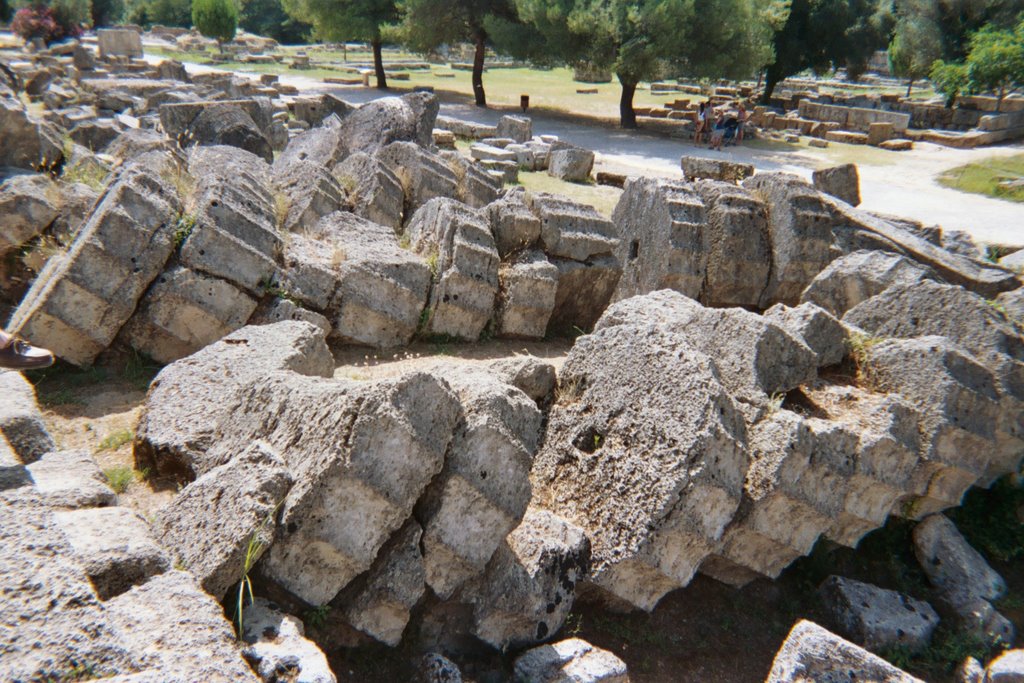 This is a picture of the tumbled columns from the Temple of Zeus in Olympia, Greece. It was taken by a student (Kimberly A.) on our trip in 2004.
Did you ever wonder... What would the ancient Greeks and Romans think about our preservation and veneration of their ruins? Would they laugh? Would they be surprised? Would they be disappointed?
Saturday, July 29, 2006
Those Seemly Summer Assignments
I have given summer assignments this year for the very first time. I have done so with hesitation and still feel very uncomfortable about the whole thing. These assignments are for my 2006-2007 Advanced Placement Vergil students only.
I have long believed that holidays were time away from work and school and have always given all my students the assignment of putting their books in their lockers until school was back in session.
Now I have given in to gentle pressure and expectations that summer assignments are a good and necessary thing. I was quite surprised when, at the end of the last AP Vergil course in 2005, my students suggested that they would have been happier and had an easier go of the AP Vergil course if they were already well-acquainted with the Aeneid before they began translating and critiquing it. They were actually disappointed that they had not received a summer assignment!
So what I have done? I collected the e-mail addresses of all my AP students so that we could remain in contact. I gave them each a copy of a Mandelbaum's translation of Vergil's Aeneid and told them that they needed to read the entire work, including the introduction and notes in the back. I then randomly assigned one of the books of the Aeneid to each student (I have 23 students so there is some overlap) and had them generate an outline of that book. They need to send that outline to me by August 1 and I will collate them all into a larger outline which I will return to them before the start of school on August 23. I have also posted a list of terms about content and background from the Aeneid which they will need to know for their major content test soon after school begins! Furthermore, each student will need to write a general essay on the life and times of the poet Vergil and turn it in on the first day of school! Ack!
My biggest concern at this point revolves around the realm of "What if...". What if the student does not meet the August 1 deadline? What if they don't do the essay? What if they do not read the Aeneid over the summer? Does that mean they start out at the beginning of the year with a zero or two and already far behind? We shall see...
All of this reflects the prevailing attitude of students toward AP classes and the work required in them. I must admit that I am not a fan of AP classes and would not be terribly disappointed if they were outlawed and ceased to exist. Imagine how surprised (and a little disturbed) I was when, several years ago, I asked my advanced Latin students if they would be disappointed if there was no AP Latin. They said that they wouldn't be... they would just take some other AP class instead!
I have long believed that holidays were time away from work and school and have always given all my students the assignment of putting their books in their lockers until school was back in session.
Now I have given in to gentle pressure and expectations that summer assignments are a good and necessary thing. I was quite surprised when, at the end of the last AP Vergil course in 2005, my students suggested that they would have been happier and had an easier go of the AP Vergil course if they were already well-acquainted with the Aeneid before they began translating and critiquing it. They were actually disappointed that they had not received a summer assignment!
So what I have done? I collected the e-mail addresses of all my AP students so that we could remain in contact. I gave them each a copy of a Mandelbaum's translation of Vergil's Aeneid and told them that they needed to read the entire work, including the introduction and notes in the back. I then randomly assigned one of the books of the Aeneid to each student (I have 23 students so there is some overlap) and had them generate an outline of that book. They need to send that outline to me by August 1 and I will collate them all into a larger outline which I will return to them before the start of school on August 23. I have also posted a list of terms about content and background from the Aeneid which they will need to know for their major content test soon after school begins! Furthermore, each student will need to write a general essay on the life and times of the poet Vergil and turn it in on the first day of school! Ack!
My biggest concern at this point revolves around the realm of "What if...". What if the student does not meet the August 1 deadline? What if they don't do the essay? What if they do not read the Aeneid over the summer? Does that mean they start out at the beginning of the year with a zero or two and already far behind? We shall see...
All of this reflects the prevailing attitude of students toward AP classes and the work required in them. I must admit that I am not a fan of AP classes and would not be terribly disappointed if they were outlawed and ceased to exist. Imagine how surprised (and a little disturbed) I was when, several years ago, I asked my advanced Latin students if they would be disappointed if there was no AP Latin. They said that they wouldn't be... they would just take some other AP class instead!
Thursday, July 27, 2006
The Colosseum in Profile
 The Flavian Amphitheater, looking good after a decent scrubbing, in July 2001. The first time or two I saw the Colosseum (early to middle 1980's), it was much dirtier and covered with layers of soot. It has been interesting watching Rome get cleaner and greener these past twenty-four years.
Saturday, July 22, 2006
The Philosopher's Kitchen
My wife is a librarian and this makes for a dangerous combination for a marriage (an embarrassing and hopelessly out of touch combo, if you ask our thirteen-year-old daughter).
Anyhow, my wife brought to my attention a wonderful book: The Philosopher's Kitchen: Recipes from Ancient Greece and Rome for the Modern Cook by Francine Segan (Random House, Inc., 2004). This cookbook contains recipes (I believe) students would actually eat. There is no talk of lark tongues, sow's bladders, or peacock brains (which, unfortunately, most students then choose to remember and confirm the general public's views of "typical" Roman food which always ends up in the "vomitorium") but reasonable and realistic items. Even more impressive, many recipes have photographs of the final product, making them look very tempting and enjoyable.
Anyhow, my wife brought to my attention a wonderful book: The Philosopher's Kitchen: Recipes from Ancient Greece and Rome for the Modern Cook by Francine Segan (Random House, Inc., 2004). This cookbook contains recipes (I believe) students would actually eat. There is no talk of lark tongues, sow's bladders, or peacock brains (which, unfortunately, most students then choose to remember and confirm the general public's views of "typical" Roman food which always ends up in the "vomitorium") but reasonable and realistic items. Even more impressive, many recipes have photographs of the final product, making them look very tempting and enjoyable.
The table of contents lists:
- Ad Gustum: Appetizers
- Fire: Soups and Stews
- Earth: Salads and Vegetables
- Water: Seafood
- Air: Poultry
- Macellum: Meats
- Panis: Breads
- Ambrosia: Desserts
- Menus and Entertaining
Opening the book at random, one finds "Herb Crisps" (p.186):
- A quote from Aesop
- A short introduction to the recipe with reference to the photograph on an earlier page
- The modern recipe
- The original recipe (from Chrysippus)
- And the entry ends with a item of interest (which are delightfully scattered throughout the textbook) which mentions how the ancient Egyptians kneaded bread with their feet.
This book is a must-have for any teacher who makes food a part of the classroom experience or anyone who loves to cook!
Also tempting... the author has penned Shakespeare's Kitchen. Now I have to find that one too!
*The fine print: I have no connection with Francine Segan or Random House Books. This is not a spam promotion. I merely found this delightful book and wanted to share the excitement.
Thursday, June 29, 2006
Classic(al) Superman
My family and I took in a matinee of the latest Superman movie today (Superman Returns) and we thoroughly enjoyed it. I could not help but pick up on the obvious and less-than-obvious classical references and allusions in the film (keep reading -- I promise not to divulge anything important to the story of the film):
- Lex Luthor, haughtily revealing his latest plot, explains that Prometheus stole fire from the gods and gave it to man, thus providing our first technology.
- Lex continues to explain that the Romans conquered the world by building roads.
- When the massive globe atop the Daily Planet totters and falls, Superman races to the rescue and catches it, striking a wonderful Hercules pose.
- Superman falls to Earth from the heavens and reminds me of the fall of Hephaestus.
- Not exactly classical, the the film absolutely drips with Christian symbolism and references.
Even if you're not into sci-fi flicks, you may like this film. Check out the reviews and go see it!
Tuesday, June 20, 2006
It never rains in Italy in the summertime...
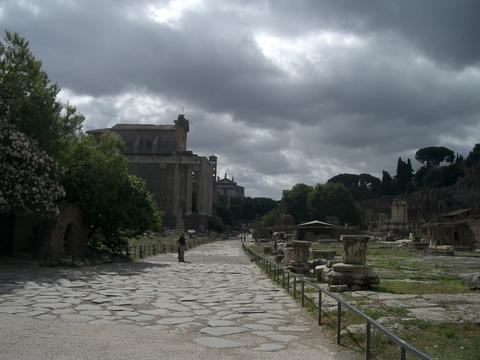 I had taken eight trips to Italy during what everyone would consider "the summer months" and had never experienced any rain. So, wise guy that I am, I always told my students that they never had to worry about umbrellas or ponchos when they packed for the trip. Leave it to Iuppiter Pluvius to prove me wrong on our trip in 2005! It was a summer cooler than normal and we experienced periods of heavy rain a couple of days during our trip. The key was to stay positive and remind the students how fortunate they were not to have to experience Italy in all its dusty and sweaty glory. I also enjoyed seeing wildflowers blooming in the Forum in July and Italy dressed in an uncharacteristic green instead of its usual golden brown.
Monday, June 19, 2006
Taking Stock of the School Year
I have just completed my 19th year of teaching and, to be sure, it was the hardest one to date. I attribute this difficulty to several changes: 1) our school system started alternating-day block scheduling this year and we had to pick up an extra class (upping our total from 5 to 6); 2) this was my first year serving as department chair (and there were not a few unusual difficulties); and 3) this was the 2nd year for our new school and the "first-year" excitement and enthusiasm is gone and we have settled into the system as another cog in the machine.
Even before the end of the school year I began to think and plan for next year. Every job should have a "summer break" to allow employees and (indeed) management the time to reflect on what is working and what isn't and what can and should be changed. This is my task for the summer and I'll start now...
What is working? I have many students who are successful in and excited about their study of Latin. They can pick up a passage of Latin, from Ecce Romani, if they are in Latin II, or from Martial, Catullus, Ovid, and Horace, if they are from Latin III through AP, and read it, translate it, and understand it. What is more, there are some who even enjoy it! Furthermore, I have students who are busy preparing projects and cramming for certamen for the upcoming National Junior Classical League convention in the end of July. They don't have to do this, but they go out of their way and pay lots of money for the opportunity to do so. Finally, I have two very dear students who just graduated and are planning to study Latin and the classics in college and they are planning to become Latin teachers! While I can't claim credit for their desire to become Latin teachers (they came to our new school with their minds already made up), I can rest comfortably that I did not dissuade them in their ambition during their last two years in high school. A few other new graduates also tell me that they will continue taking Latin in college just for the fun of it. Do I hear angels singing?
What is not working? I have some students on the other end of the spectrum who hate Latin, really dislike me, and ended the year with very low averages or even failed the class. These are students who tell me (as do their parents) that Latin is their only low grade and that their Latin grade was bringing down their GPA. Now, I learned many years ago that there is no way to have or make everyone satisfied or happy and I will not even attempt it, but this always leaves me pondering what I could do better or how I can help my students out. I do know that I could do a much better job grading papers and getting them back to the students. I could be more proactive and contact parents sooner or more frequently when a student is struggling or even sinking.
What can and should be changed? The biggest thing here is staying organized, staying on top of all the paperwork and administrivia that comes my way. All too often the end of the day comes (after make up work, Latin Club, certamen practice, etc.) and I gather up all the things that need to be done and shove them in my bag to be carted home. Sometimes I pull these items out at home and give them some attention and sometimes these items, having never seen the light of the lamp, simply enjoy the ride back to school. In either case, I take the precious time, if any is available, to reshuffle the papers and get them back into their requisite piles. This has got to stop. I found that forcing myself to stay even later after school (until 5 p.m. or more) to handle these papers gave me the opportunity to handle them, file them, or discharge them without having to sift and sort. Likewise, using this time to grade papers and them into the class folders for the next day makes grading more efficient and convenient. I can them make my way home and enjoy my family without the thoughts of all this pulp and ink hanging over my head. Ask any teacher, he or she certainly knows what Damocles felt! This fall I will certainly continue this practice of addressing work at work and taking time for myself at home. I will not be naive to believe that I will never do work at home anymore, but I can definitely lighten the load and be reasonable in the understanding of what I can actually accomplish at home in the evening.
What else can and should be changed? I will make the effort to have those students who need extra help stay after school and receive the help they need. I have always waited until they initiate the call for help, but some wait until the problem has become a crisis or don't even ask at all. Since we now have block scheduling (90 minute classes every other day) and I have more of a clue how this set up works, I am considering breaking up the time in class and and differentiating activities in such a way that those who need reteaching or more practice can receive it from me in a special help group and those who wish and need to excel can have the opportunity to work on special projects or assignments before we reconvene for new material, checking activities, or otherwise moving ahead. I can set aside time after school to set up tutoring sessions for those who desire them. I can seek out volunteers from my advanced students to help teach, reteach, review, and practice.
Now comes the task of making it all happen. I will revisit these thoughts as the summer comes to a close and the new school year starts ramping up. Now is the luscious time for thought, reflection, tinkering, and trashing. Send in the clowns!
Even before the end of the school year I began to think and plan for next year. Every job should have a "summer break" to allow employees and (indeed) management the time to reflect on what is working and what isn't and what can and should be changed. This is my task for the summer and I'll start now...
What is working? I have many students who are successful in and excited about their study of Latin. They can pick up a passage of Latin, from Ecce Romani, if they are in Latin II, or from Martial, Catullus, Ovid, and Horace, if they are from Latin III through AP, and read it, translate it, and understand it. What is more, there are some who even enjoy it! Furthermore, I have students who are busy preparing projects and cramming for certamen for the upcoming National Junior Classical League convention in the end of July. They don't have to do this, but they go out of their way and pay lots of money for the opportunity to do so. Finally, I have two very dear students who just graduated and are planning to study Latin and the classics in college and they are planning to become Latin teachers! While I can't claim credit for their desire to become Latin teachers (they came to our new school with their minds already made up), I can rest comfortably that I did not dissuade them in their ambition during their last two years in high school. A few other new graduates also tell me that they will continue taking Latin in college just for the fun of it. Do I hear angels singing?
What is not working? I have some students on the other end of the spectrum who hate Latin, really dislike me, and ended the year with very low averages or even failed the class. These are students who tell me (as do their parents) that Latin is their only low grade and that their Latin grade was bringing down their GPA. Now, I learned many years ago that there is no way to have or make everyone satisfied or happy and I will not even attempt it, but this always leaves me pondering what I could do better or how I can help my students out. I do know that I could do a much better job grading papers and getting them back to the students. I could be more proactive and contact parents sooner or more frequently when a student is struggling or even sinking.
What can and should be changed? The biggest thing here is staying organized, staying on top of all the paperwork and administrivia that comes my way. All too often the end of the day comes (after make up work, Latin Club, certamen practice, etc.) and I gather up all the things that need to be done and shove them in my bag to be carted home. Sometimes I pull these items out at home and give them some attention and sometimes these items, having never seen the light of the lamp, simply enjoy the ride back to school. In either case, I take the precious time, if any is available, to reshuffle the papers and get them back into their requisite piles. This has got to stop. I found that forcing myself to stay even later after school (until 5 p.m. or more) to handle these papers gave me the opportunity to handle them, file them, or discharge them without having to sift and sort. Likewise, using this time to grade papers and them into the class folders for the next day makes grading more efficient and convenient. I can them make my way home and enjoy my family without the thoughts of all this pulp and ink hanging over my head. Ask any teacher, he or she certainly knows what Damocles felt! This fall I will certainly continue this practice of addressing work at work and taking time for myself at home. I will not be naive to believe that I will never do work at home anymore, but I can definitely lighten the load and be reasonable in the understanding of what I can actually accomplish at home in the evening.
What else can and should be changed? I will make the effort to have those students who need extra help stay after school and receive the help they need. I have always waited until they initiate the call for help, but some wait until the problem has become a crisis or don't even ask at all. Since we now have block scheduling (90 minute classes every other day) and I have more of a clue how this set up works, I am considering breaking up the time in class and and differentiating activities in such a way that those who need reteaching or more practice can receive it from me in a special help group and those who wish and need to excel can have the opportunity to work on special projects or assignments before we reconvene for new material, checking activities, or otherwise moving ahead. I can set aside time after school to set up tutoring sessions for those who desire them. I can seek out volunteers from my advanced students to help teach, reteach, review, and practice.
Now comes the task of making it all happen. I will revisit these thoughts as the summer comes to a close and the new school year starts ramping up. Now is the luscious time for thought, reflection, tinkering, and trashing. Send in the clowns!
Wednesday, May 17, 2006
Living the Happy Life
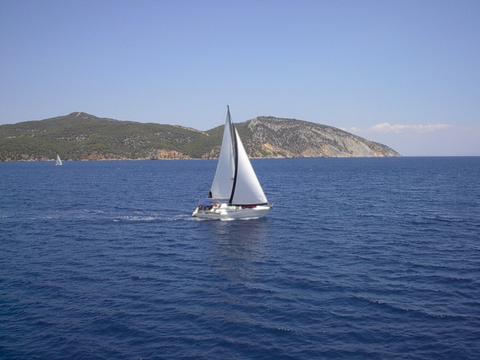 I offered this poem to my Latin III students recently. They dutifully translated it, but, as it should be, they did not appreciate the message:
Martial X.47: "Living the Happy Life" Vitam quae faciant beatiorem, Iucundissime Martialis, haec sunt: Res non parta labore, sed relicta; Non ingratus ager, focus perennis; Lis numquam, toga rara, mens quieta; Vires ingenuae, salubre corpus; Prudens simplicitas, pares amici; Convictus facilis, sine arte mensa; Nox non ebria, sed soluta curis; Non tristis torus, et tamen pudicus; Somnus, qui faciat breves tenebras: Quod sis, esse velis nihilque malis; Summum nec metuas diem nec optes.And here is my (somewhat free) translation:
Martial, my good man, these things make for a happier life: stuff not gotten from work, but left to you; a happy garden, always a fire in the stove; never being called to court, a little-used suit, a mind at peace; free-born strength, a healthy body; straight-talking wisdom and friends who feel the same way; modest entertainment, simple food; not partying all night, but free from cares; not sleeping alone, but not around either; dreams which make the night pass quickly: may you want to be who you are and long for nothing; may you neither dread your final day nor look forward to it.Certainly words of wisdom which could have been typed by anyone seeking to shut out the frenzy of the modern world and not penned by someone over 1,900 years ago.
Tuesday, May 16, 2006
Cheering for Compositions
Composition, the translation of English into Latin, has long been a chore for students learning Latin. I've always enjoyed the mental exercise and find it to be a useful teaching activity. What other assignment requires students to apply everything they've practiced and learned in one, neat, little package? My students, though, can find it tedious and even frustrating. I'm sure that I'm not the only teacher who has this experience!
I do have a game we play occasionally to make composition more interesting and exciting... turn it into a competition!
This is what I do:
1) Divide the students into three teams. You can do this randomly or assign them by ability to get a good combination on each team.
2) Divide your blackboard/whiteboard into three sections; assign each team to a section. Keep the sections close together so that you can see all three at the same time.
3) Announce that each team will be translating the same sentence into Latin and the first team that gets the sentence completely correct will win the point or get credit. Here's the catch: each team puts their sentence on the board but the teacher can only say, "There are no correct sentences on the board" until one of them is completely correct. The teacher can offer no assistance or even tell the teams where the problems are -- that is the job of each team to determine.
4) Continue assigning sentences from a list or an exercise in the textbook as time and tolerance will allow. The team with the most points at the end of the game will receive credit, extra credit, or some other reward.
Suggestions:
A) Only one person from a team at the board at a time. This allows the teacher to see the whole board and determine which sentence is correct first. Students have to "tag team" to get to the board. A team shouting at a member on the board often leads to confusion or frustration. Have the team member return to the group's huddle.
B) Don't assign the sentences for homework ahead of time. One diligent student can dominate the team and the whole game.
C) Don't worry about teams "copying" the sentences from other teams on the board. This is part of the learning process. Also, savvy teams have been known to leave an obvious error which can lead another team astray but can be easily corrected to catch the win.
D) Encourage the members of each team to work together to figure out the sentence. When the pressure is on and there are three incorrect sentences on the board, the suggestion or idea of everyone on the team can make the difference between winning or losing.
E) You can make more than three teams if you have enough board space and you feel comfortable looking at multiple sentences at the same time.
I have found no other technique which makes translating into Latin so exciting. To hear students cheer when they have translated a sentence correctly is truly music to a Latin teacher's ears!
I do have a game we play occasionally to make composition more interesting and exciting... turn it into a competition!
This is what I do:
1) Divide the students into three teams. You can do this randomly or assign them by ability to get a good combination on each team.
2) Divide your blackboard/whiteboard into three sections; assign each team to a section. Keep the sections close together so that you can see all three at the same time.
3) Announce that each team will be translating the same sentence into Latin and the first team that gets the sentence completely correct will win the point or get credit. Here's the catch: each team puts their sentence on the board but the teacher can only say, "There are no correct sentences on the board" until one of them is completely correct. The teacher can offer no assistance or even tell the teams where the problems are -- that is the job of each team to determine.
4) Continue assigning sentences from a list or an exercise in the textbook as time and tolerance will allow. The team with the most points at the end of the game will receive credit, extra credit, or some other reward.
Suggestions:
A) Only one person from a team at the board at a time. This allows the teacher to see the whole board and determine which sentence is correct first. Students have to "tag team" to get to the board. A team shouting at a member on the board often leads to confusion or frustration. Have the team member return to the group's huddle.
B) Don't assign the sentences for homework ahead of time. One diligent student can dominate the team and the whole game.
C) Don't worry about teams "copying" the sentences from other teams on the board. This is part of the learning process. Also, savvy teams have been known to leave an obvious error which can lead another team astray but can be easily corrected to catch the win.
D) Encourage the members of each team to work together to figure out the sentence. When the pressure is on and there are three incorrect sentences on the board, the suggestion or idea of everyone on the team can make the difference between winning or losing.
E) You can make more than three teams if you have enough board space and you feel comfortable looking at multiple sentences at the same time.
I have found no other technique which makes translating into Latin so exciting. To hear students cheer when they have translated a sentence correctly is truly music to a Latin teacher's ears!
Sunday, May 14, 2006
Amy High Latin Foundation
I attended a fundraiser for the Amy High Latin Foundation on Saturday, May 13. I decent event, all in all. One of the highlights was a demonstration by the Legio XX:
 It seems there is a living history event called Roman Days 2006 coming up in Maryland the weekend of June 3-4, 2006. I just might have to check it out!
But back to the subject of my post... Amy High was a dynamic teacher who taught Latin on all levels, her last assignment was teaching third-graders in Fairfax County, VA. You may have seen an article on her in Time magazine back in December of 2000. You may also remember her as Iulia Pauli, the roving reporter in the Forum Romanum video series produced by the National Latin Exam. Tragically, Amy died a few years ago. She loved traveling to Rome and studying oral Latin under Reginald Foster, the Latin cleric to the Pope. As her legacy, her husband and several very close friends established the Amy High Latin Foundation to support aspiring and experienced Latin teachers who have a desire to travel to the Eternal City and study. To date, the foundation has awarded more than $30,000 in scholarships.
If you are a Latin teacher (or will soon become one) and have any interest in traveling to Rome to brush up on your oral Latin skills, this is a valuable source of inspiration and funding.
Finally, the Foundation is always looking for donations. If you have extra funds in need of a worthy cause, this is one of the "biggies" for the study of oral Latin.
Friday, April 21, 2006
From Humble Beginnings
April 21st has arrived and provides us with the opportunity to reread Livy and revisit the founding of Rome:
Ita Numitori Albana re permissa Romulum Remumque cupido cepit in iis locis ubi expositi ubique educati erant urbis condendae. (Livy's Ab Urbe Condita, I.vi)
Further down the passage we read (in a nice chiastic relationship, Palatium Romulus Remus Aventinum) that Romulus prefers the Palatine Hill for his bird-watching and, later, his city-founding.
Anyone who has ever climbed the path up the Palatine is immediately rewarded for his efforts by the appearance of tall trees and green grass, a welcome change to the usually hot and dusty Roman Forum through which the hill is reached. There is also the splendor of a Renaissance villa and the jumble of Imperial, Republican, and even Regal ruins. This hodge-podge is quickly overwhelming to the eye and causes many a tourist to snap a few, quick, panoramic photos of brick walls and marble floors and hustle back down the hill.
The gems of the place, available to anyone willing to spend the time and effort to sort out the rubble, include the marble flooring and other architectural details from the numerous palaces of the Roman emperors, the impressive frescoes in the House of Livia, the postholes from the Hut of Romulus, and spectacular vistas of the Roman Forum and the rest of the City.
My favorite place on this sparkling list is the one which looks the least impressive to most visitors but is very inspiring to me: the Hut of Romulus. Several postholes, outlining the circumference of a small hut, can be seen in the natural bedrock. Nearby there are other postholes and the remains of a rustic wall and cistern. When I show this site to students and others, they are immediately struck by the small size and lack of grandeur. They often reply, "That's it? This is the actual hut? Did Romulus really lay there on a grass mat and plot the rape of the Sabine women? How do we really know?" Then they usually snap a quick pic and ask if they can head down the hill.
Of course the site is unimpressive. The importance comes in its symbolic meaning. The Romans believed that this was the site of Romulus' hut and that's good enough for me. Even if the scanty remains are those of Romulus' annoying neighbor who always allowed his dog to do his duty in everyone else's yard, it doesn't matter. What I find important is that this site is the most direct link we have to that April day so very long ago and that this hut, or one so very like it, gave rise to the massive and sprawling palaces that surround it.
Friday, April 07, 2006
Of Olives, Figs, Dates, and Grapes
In Latin II we have been discussing Roman food and dining habits. Of course we covered reclining in the triclinium, garum, olive oil, and the undying myth of the vomitorium.
I always like to teach about the food and dining of the typical Roman on a typical day. We do talk about the banquets and the drinking parties, but it is the everyday element I like to stress. With that in mind we have a food-tasting day in which students bring in and sample different types of crusty, whole-grained, rustic breads, flatbreads, different varieties of cheeses, green and black olives (with pits in situ, soaking in jars, not tinny-tasting cans), figs, dates, grapes, a wide selection of fruits and vegetables, olive oil, honey, and grape juice.
I am always amazed at the students who have never tasted an olive or honey or even cheese that doesn't come wrapped in its individual plastic sleeve and think that figs only exist in a newton. I encourage them to keep an open mind and try at least something new. Some really do expand their palate.
What is popular with my students in recent years, due largely to the practice in some of our local Italian restaurants, is dipping (or even soaking!) crusty bread in olive oil. Now if I could just get them to rub some garlic on it first!
I have, of course, done the Roman banquet thing in the past and have found that it is not worth the time and expense of having students (and their parents) whip up a "real Roman dish" and then have students refuse to taste it. Keeping it simple is always a plus!
I always like to teach about the food and dining of the typical Roman on a typical day. We do talk about the banquets and the drinking parties, but it is the everyday element I like to stress. With that in mind we have a food-tasting day in which students bring in and sample different types of crusty, whole-grained, rustic breads, flatbreads, different varieties of cheeses, green and black olives (with pits in situ, soaking in jars, not tinny-tasting cans), figs, dates, grapes, a wide selection of fruits and vegetables, olive oil, honey, and grape juice.
I am always amazed at the students who have never tasted an olive or honey or even cheese that doesn't come wrapped in its individual plastic sleeve and think that figs only exist in a newton. I encourage them to keep an open mind and try at least something new. Some really do expand their palate.
What is popular with my students in recent years, due largely to the practice in some of our local Italian restaurants, is dipping (or even soaking!) crusty bread in olive oil. Now if I could just get them to rub some garlic on it first!
I have, of course, done the Roman banquet thing in the past and have found that it is not worth the time and expense of having students (and their parents) whip up a "real Roman dish" and then have students refuse to taste it. Keeping it simple is always a plus!
Monday, April 03, 2006
The Temple of Apollo at Delphi
It has been too long since I posted a picture so I offer this image of the Temple of Apollo at Delphi:
 I took this photograph in July 2004 - I use it as the background screen of my computer.
 I took this photograph in July 2004 - I use it as the background screen of my computer.
I'll Do It Tomorrow...
The poet Martial writes in Epigram V.58:
This poem has come up in class at a very interesting time. It is the end of the marking period and I have just spent a very unpleasant weekend grading papers, tests, essays, and make-up work. When I say that I spent the weekend, I mean, literally, the whole weekend.
The first part of the problem comes from my own procrastination. I let the papers pile up and then they become a chore. When they become a chore, they are avoided. When they are avoided, they hang over my head and make me more anxious than any sword of Damocles.
The second part of the problem I attribute to overextending myself and saying "yes" to far too many things when I am already taxed. We moved to block scheduling this year and that means three 90-minute shows a day, each show different, interesting, and, I hope, productive.
Finally, I am beginning to realize that the third part of the problem is that I am requiring too much graded work from my students. There are quizzes on vocabulary, grammar, syntax, translations, culture, history, mythology, and then tests, benchmark tests, and exams. I also require prepared translations and exercises and even the occasional poster or project. Those who are marginal students are quickly overwhelmed and become discouraged. In frustration they come to hate the study of Latin, regret their decision of taking it, and refuse to go on.
My realization, some twenty years after I started teaching: not everything requires work, not all work requires a grade, and not every grade needs to be recorded. As a young teacher fresh out of college I would have considered this blasphemy. Now, as an experienced teacher in the middle of my career, I realize that this is the approach that will allow me to see the wisdom of Martial's words.
Cras te victurum, cras dicis, Postume, semper:And I offer this translation:
dic mihi, cras istud, Postume, quando venit?
Quam longe cras istud! ubi est? aut unde petendum?
Numquid apud Parthos Armeniosque latet?
Iam cras istud habet Priami vel Nestoris annos.
Cras istud quanti, dic mihi, possit emi?
Cras vives? Hodie iam vivere, Postume, serum est:
ille sapit quisquis, Postume, vixit heri.
You always say that you will live tomorrow, Postumus, tomorrow!
Tell me, that tomorrow of yours, Postumus, when does it come?
How far away that tomorrow is! Where is it? Where must we look for it?
Does it hide out among the Parthians and Armenians?
That tomorrow of yours is already as old as Priam or Nestor.
Tell me, how much will that tomorrow of yours cost?
Will you live tomorrow? Postumus, it is already too late to live today:
He is wise whoever lived yesterday, Postumus!
This poem has come up in class at a very interesting time. It is the end of the marking period and I have just spent a very unpleasant weekend grading papers, tests, essays, and make-up work. When I say that I spent the weekend, I mean, literally, the whole weekend.
The first part of the problem comes from my own procrastination. I let the papers pile up and then they become a chore. When they become a chore, they are avoided. When they are avoided, they hang over my head and make me more anxious than any sword of Damocles.
The second part of the problem I attribute to overextending myself and saying "yes" to far too many things when I am already taxed. We moved to block scheduling this year and that means three 90-minute shows a day, each show different, interesting, and, I hope, productive.
Finally, I am beginning to realize that the third part of the problem is that I am requiring too much graded work from my students. There are quizzes on vocabulary, grammar, syntax, translations, culture, history, mythology, and then tests, benchmark tests, and exams. I also require prepared translations and exercises and even the occasional poster or project. Those who are marginal students are quickly overwhelmed and become discouraged. In frustration they come to hate the study of Latin, regret their decision of taking it, and refuse to go on.
My realization, some twenty years after I started teaching: not everything requires work, not all work requires a grade, and not every grade needs to be recorded. As a young teacher fresh out of college I would have considered this blasphemy. Now, as an experienced teacher in the middle of my career, I realize that this is the approach that will allow me to see the wisdom of Martial's words.
Thursday, March 30, 2006
Why Do I Teach?
“Those who can, do; those who can’t, teach.” I think I first heard this smirky phrase when I was a student in high school. I probably even laughed along with it. After all, I never intended to be a teacher. I entered into Virginia Tech planning to major in math and computer science. I was going to get a high-tech job and bring home some high-tech money. So how did I end up teaching Latin? I had taken four years of Latin in high school and kept it on my college schedule just for fun. I wasn’t ready to give up something in which I had invested so much time and effort. It was my comforting diversion from all those numbers, proofs, and commands. As I slogged my way through five-hour freshman calculus and computer science classes stuffed full of math geniuses and techie wannabes, I took a look around one day and asked myself, “Do I really want to do this with my life? Do I really want to chain myself to a desk and stare into a computer screen all day long?” Searching my soul and receiving a bit of advice from those who knew me better than I knew myself, I realized that the world of numbers and crunching them wasn’t for me and I turned my diversion into my vocation. In the spirit of Robert Frost who knew something about wandering around the woods, I went from the major of the masses to the major of the obscure few and, indeed, that distinction made all the difference.
I have loved the ancient world as far back as I can remember. I recall being thrilled when I flipped through the television channels as a child and stumbled upon such wonders as Ben Hur racing his chariot, Spartacus leading his army of slaves, or even Bugs Bunny and Daffy Duck being chased by lions in the Colosseum. I fondly remember discovering my mother’s Latin textbook, opening it at random, and resting my eyes on the Latin word amicitia - “friendship.” Ever since that time I have nourished this friendship with the ancient world and turned it into a love affair.
Taking the less-traveled road of being a Latin teacher, though, does come with a challenge. I have been part of many conversations which play out in a predictable direction. I meet somebody new and she asks, “What do you do?” “I teach,” I reply. “Oh, really?” she says, often with some sort of surprise or disappointment in her voice. “What do you teach?” “I teach Latin!” I say with pride and look her straight in the eyes, knowing her reaction will come in one of two ways: 1) her eyes open wide and she responds with amazement, “Do they really still teach that? Isn’t Latin a dead language?” or 2) her eyes narrow, her top lip curls, and she responds with disdain, “I hated Latin when I was in school! I can’t remember a thing and it never helped me out anyway!” On occasion I will come across the individual who actually loved taking Latin in high school, admitting how he benefited from Latin in learning English vocabulary or grammar, in conquering the SATs, or in getting an A in some other, now-forgotten, Romance language. All too often, though, a parent will admit that his child was taking Latin and, although he really wished his son had taken a more practical language, “You know -- something he can really use!” he was actually enjoying the class.
I take in all these responses, often with a nod and a grin, and remain confident that what I am doing with my life is a good thing. I do not have to remind myself that I get to spend all day working with a subject I love and even getting paid for it! What is more, I get to pass on to others my affection for Latin and watch with pride as they learn and grow. I do not have any misconceptions that all my students will share in my enthusiasm or even develop their own friendship with the ancient world. Indeed I dare to say that some will take a year or two of the language and make conversation in the not-too-distant future about how they are surprised that Latin is still in the curriculum or that they had an awful time having to do all that work back in high school and still didn’t get a 2400 on their SATs. On the other hand, there will be those lucky few who persevere and reach the upper levels, reading and translating works of authentic Latin literature which contain messages still fresh, meaningful, and practical two thousand years later. Those who stay with the subject through their senior year not only take fours years of Latin, but also take four years of Mr. Keith. That is a scary thought. I know that this carries with it great responsibility and I stand in my pulpit and wield my pen carefully and thoughtfully. I like to think that they move off into this world with a bit more knowledge and wisdom than when they entered high school. That, in essence, is the very nature of education. They will become the mathematicians and the computer scientists and a host of other professions, some of which we haven’t even begun to imagine, and they will take with them a touch of humanity. It is my hope that I have taught them not only how to think but that I have given them something to think about.
Why do I teach? I teach because I can.
This essay was my entry in a contest for Riverbend HS faculty in 2005.
I have loved the ancient world as far back as I can remember. I recall being thrilled when I flipped through the television channels as a child and stumbled upon such wonders as Ben Hur racing his chariot, Spartacus leading his army of slaves, or even Bugs Bunny and Daffy Duck being chased by lions in the Colosseum. I fondly remember discovering my mother’s Latin textbook, opening it at random, and resting my eyes on the Latin word amicitia - “friendship.” Ever since that time I have nourished this friendship with the ancient world and turned it into a love affair.
Taking the less-traveled road of being a Latin teacher, though, does come with a challenge. I have been part of many conversations which play out in a predictable direction. I meet somebody new and she asks, “What do you do?” “I teach,” I reply. “Oh, really?” she says, often with some sort of surprise or disappointment in her voice. “What do you teach?” “I teach Latin!” I say with pride and look her straight in the eyes, knowing her reaction will come in one of two ways: 1) her eyes open wide and she responds with amazement, “Do they really still teach that? Isn’t Latin a dead language?” or 2) her eyes narrow, her top lip curls, and she responds with disdain, “I hated Latin when I was in school! I can’t remember a thing and it never helped me out anyway!” On occasion I will come across the individual who actually loved taking Latin in high school, admitting how he benefited from Latin in learning English vocabulary or grammar, in conquering the SATs, or in getting an A in some other, now-forgotten, Romance language. All too often, though, a parent will admit that his child was taking Latin and, although he really wished his son had taken a more practical language, “You know -- something he can really use!” he was actually enjoying the class.
I take in all these responses, often with a nod and a grin, and remain confident that what I am doing with my life is a good thing. I do not have to remind myself that I get to spend all day working with a subject I love and even getting paid for it! What is more, I get to pass on to others my affection for Latin and watch with pride as they learn and grow. I do not have any misconceptions that all my students will share in my enthusiasm or even develop their own friendship with the ancient world. Indeed I dare to say that some will take a year or two of the language and make conversation in the not-too-distant future about how they are surprised that Latin is still in the curriculum or that they had an awful time having to do all that work back in high school and still didn’t get a 2400 on their SATs. On the other hand, there will be those lucky few who persevere and reach the upper levels, reading and translating works of authentic Latin literature which contain messages still fresh, meaningful, and practical two thousand years later. Those who stay with the subject through their senior year not only take fours years of Latin, but also take four years of Mr. Keith. That is a scary thought. I know that this carries with it great responsibility and I stand in my pulpit and wield my pen carefully and thoughtfully. I like to think that they move off into this world with a bit more knowledge and wisdom than when they entered high school. That, in essence, is the very nature of education. They will become the mathematicians and the computer scientists and a host of other professions, some of which we haven’t even begun to imagine, and they will take with them a touch of humanity. It is my hope that I have taught them not only how to think but that I have given them something to think about.
Why do I teach? I teach because I can.
This essay was my entry in a contest for Riverbend HS faculty in 2005.
Thursday, March 23, 2006
The Relevance of Leonardo da Vinci
 A poster of Leonardo da Vinci arrived in the mail the other day. Actually it was a promotion for a travel company, but I took it to the paper cutter, removed the advertisement from the bottom, and shamelessly added to the decor of my classroom. I posted Leo on the white board with magnets and now he watches over my students as they practice their synopses.
I was quite surprised at the reaction of my students to this image. Some students knew him immediately at sight; of course, everyone had heard of him. What they did not understand was why I had chosen to give him space in the first place. This became that proverbial "teachable moment".
I first mentioned that Leonardo da Vinci was an artist and inventor from the Italian Renaissance. I went on to explain that "renaissance" comes from the Latin verb renascor meaning "rebirth" and that the Renaissance was a rebirth of Greek and Roman ideals in art and literature. This then led to a brief discussion of the authors who wrote in Latin during that time period. I had never really talked about the history of Latin literature and most students assumed that writing in Latin went out of vogue with the arrival of the Visigoths.
I then revealed that the name of this artist was correctly "Leonardo" and that "da Vinci" was not his last name but was the Italian phrase meaning "from Vinci" and that to refer to him simply as "da Vinci" was incorrect. Students then quickly jumped with the statement that the title The Da Vinci Code was wrong. I agreed.
What happened next was very surprising and enlightening to me. A student, obviously exasperated and even a bit critical, cried out, "Who knows this? Why does it matter?" I replied that he now knows this and it matters because it is important to get things correct and to understand the truth. His point was that everyone knows who you mean when you say "da Vinci" and it might as well be his last name.
This whole experience has reinforced in me the notion that what we teach must be relevant to today's students or they will pass it off as meaningless trivia and, therefore, not worthy of their attention. Whenever I teach an item of Latin grammar or syntax, I always teach the English equivalent first so that they might understand better their own language. Likewise, my advanced students can certainly tell you that I work to compare the human experiences expressed two thousand years ago by Vergil, Ovid, Catullus, Martial, et al. to those felt by human beings today.
Sunday, March 19, 2006
Early Roman History in Rhyme
I came across The Faber Book of Useful Verse, edited by Simon Brett (London: Faber and Faber, Ltd, 1981) on my shelves today and found this wonderful entry:
The verse is attributed to Edward B. Goodwin who wrote around 1875. There is some indication that this may be part of a larger work. If anyone knows where we can find more, please let me know. I'll start looking on this end...
Aeneas built, in days of yore,
Lavinium on the Latin shore;
And Alba Longa's power was feared
Until the walls of Rome appeared,
By Romulus at length upreared.
The tribes that dwelt there first were these:
The Ramnes, Tities, Luceres.
When Romulus had left this earth,
Wise Numa reigned, of Sabine birth,
Who temples built, and pontiffs chose.
But Tullus combated his foes:
Three brothers with three brothers vie --
Horatii, Curiatii.
And Ancus made the Ostian port,
Sublician bridge, and many a fort.
The verse is attributed to Edward B. Goodwin who wrote around 1875. There is some indication that this may be part of a larger work. If anyone knows where we can find more, please let me know. I'll start looking on this end...
Saturday, March 18, 2006
RomeGiftShop.com
Can you believe it? Now that the secret is out, never again must we huddle our students into the back of a plane and cart them off to Italy in order to purchase a plaster-of-paris copy of the Colosseum or Michelangelo's David! We can now order all our must-have, Roman souvenir items from the comfort of our own homes!
Dr. Greg Daugherty of Randolph-Macon College in Ashland, Virginia, has alerted us of the existence of RomeGiftShop.com, which includes items not only commemorative of your trip to Italy, such as rosaries and flags of the Roma soccer team, but items of classical interest as well, including replicas of Roman coins, miniature Roman soldiers, books, posters, and more! Many items come with a complimentary postcard of the Colosseum mailed from the Eternal City!
Please don't get me wrong... Some of this is great stuff and sine qua non to the Latin classroom. Run, don't walk, to their website today! Push, shove, scream, and shout! Form a good, Italian line at their door! Andiamo!
Dr. Greg Daugherty of Randolph-Macon College in Ashland, Virginia, has alerted us of the existence of RomeGiftShop.com, which includes items not only commemorative of your trip to Italy, such as rosaries and flags of the Roma soccer team, but items of classical interest as well, including replicas of Roman coins, miniature Roman soldiers, books, posters, and more! Many items come with a complimentary postcard of the Colosseum mailed from the Eternal City!
Please don't get me wrong... Some of this is great stuff and sine qua non to the Latin classroom. Run, don't walk, to their website today! Push, shove, scream, and shout! Form a good, Italian line at their door! Andiamo!
Wednesday, March 15, 2006
The Modern Ides of March

"Beware the Ides of March!" Many people will playfully tout this warning today without being completely aware of what they are saying. We owe the popularity of this phrase not to Julius Caesar or any other ancient Roman, but to a man who lived over 1600 years later -- the venerated William Shakespeare.
In Act I, Scene ii in Julius Caesar, Shakespeare writes,
Caesar:
Who is it in the press that calls on me?
I hear a tongue shriller than all the music
Cry Caesar. Speak; Caesar is turned to hear.
Soothsayer:
Beware the ides of March.
Caesar:
What man is that?Brutus:
A soothsayer bids you beware the ides of March.Caesar:
Set him before me, let me see his face.Cassius:
Fellow, come from the throng, look upon Caesar.Caesar:
What sayest thou to me now? Speak once again.Soothsayer:
Beware the ides of March.Caesar:
He is a dreamer, let us leave him. Pass.
Shakespeare has the soothsayer warn Caesar of the Ides; and Caesar chooses not to heed this warning because he could not or would not live his life in fear. In Act II, Scene ii, when Calpurnia begs him to stay home from the meeting of the Senate scheduled for the Ides, Caesar refuses to heed his wife and utters his immortal phrase,
Cowards die many times before their deaths,
The valiant never taste of death but once.
And later in Act III, Scene i, Caesar comes across the soothsayer on the way to the meeting of the Senate,
Caesar:
The ides of March are come.Soothsayer:
Ay Caesar, but not gone.
Since the time of Shakespeare's play (1599), the phrase "Beware the Ides of March!" has become the work's popular legacy and, when used in modern context, has come to mean, "Open your eyes and look at what is happening! Pay attention to what's going on around you or bad things are going to happen! Don't say we didn't warn you!"
A side effect of the whole Ides of March pronouncement is the common notion that the Ides fall on the 15th of every month. Indeed, many believe that another bloody Ides comes a month later with the annual deadline for filing income taxes in April. In reality, the Ides fall on the 13th of every month with the exception of March, May, July, and October.
Next, we come to the discussion of Julius Caesar's dying words. Plutarch writes that Caesar said nothing, but simply pulled his toga over his head at the sight of Brutus (Parallel Lives: The Life of Julius Caesar, 66.12). Suetonius (De Vita Caesarum LXXXII) states that Caesar's last words, aimed at Brutus, were in Greek "Kai su, teknon?" ("You too, son?"). Again, our experience with this event comes from Shakespeare who makes Caesar's last gasp the popular, "Et tu, Brute?" ("Even you, Brutus?"). This phrase, in both ancient and modern context, has come to represent an expression of surprise or disappointment that someone is a part of something you never would have expected. You have been betrayed!
Finally, I have seen numerous versions of Shakespeare's Julius Caesar, some of them very good and some barely memorable. The best death scene, though, comes from a production I saw several years ago at the Shenandoah Shakespeare Black Friar's Theater in Staunton, Virginia. Caesar enters the Senate triumphantly, sporting a regal, red sash around his white, tailored suit. He climbs the stairs to the seat and is, in due course, murdered. As he dies, he falls down the stairs, unwinding his sash as he rolls, leaving behind a trail of blood.
It is interesting how great an effect the literature of Shakespeare has had upon our understanding and memory of historical events.
Tuesday, March 14, 2006
Roman Noodles...
A little while ago there was a request on the LatinTeach list for a good mnemonic device to remember the kings of Rome. The one I use is:
Roman = Romulus
Noodles = Numa Pompilius
Toss = Tullus Hostilius
And = Ancus Marcius
Turn; = Tarquinius Priscus
Serve = Servius Tullius
Them! = Tarquinius Superbus
I think the "Serve" is my variation (the original had "Save")... but I give credit for the whole phrase to the inimitable Susan Schearer, now retired from John Handley High School in Winchester, VA. If someone has another provenance for this, please let me know!
P.S. The allusion to pasta is a nice touch!
Roman = Romulus
Noodles = Numa Pompilius
Toss = Tullus Hostilius
And = Ancus Marcius
Turn; = Tarquinius Priscus
Serve = Servius Tullius
Them! = Tarquinius Superbus
I think the "Serve" is my variation (the original had "Save")... but I give credit for the whole phrase to the inimitable Susan Schearer, now retired from John Handley High School in Winchester, VA. If someone has another provenance for this, please let me know!
P.S. The allusion to pasta is a nice touch!
Sunday, March 12, 2006
Thomas Jefferson Made Me Do It
 When people ask why the study of Latin and the classics is so popular in Virginia, I usually tell them that it is all Thomas Jefferson's fault. When he founded the University of Virginia in 1825, he made sure that Latin, Greek, and the classics were a cornerstone to a solid and rewarding education.
One of my favorite quotes from Mr. Jefferson is from a letter he sent to a Dr. Joseph Preistly. On January 27, 1800, he wrote, "to read the Latin and Greek authors in their original, is a sublime luxury as in architecture, painting, gardening, or other arts. I enjoy Homer in his own language infinitely beyond Pope's translation of him, and both beyond the dull narrative of the same events by Dares Phrygius; and it is an innocent enjoyment. I thank on my knees, him who directed my early education, for having put into my possession this rich source of delight; and I would not exchange it for anything which I could then have acquired, or have not since acquired."
Friday, March 10, 2006
National Latin Teacher Recruitment Week 2006
 I took the first few minutes of my classes these past two days and spoke to my students about the desperate need for teachers -- good teachers. As expected, I was met with surprise, amusement, silent stares, nods, and even agreement. Some students seemed very receptive and a few concurred even though they didn't want their peers to know.
My approach began with the need for teachers in general, how in our district (Spotsylvania County, Virginia) most of our new teachers come from Pennsylvania, New York, and, this year, Michigan. A few were even recruited in the Philippines! I talked about the need for math teachers, science teachers, and then launched into the crying need for Latin teachers. Most did not know this was to become a conversation about becoming Latin teachers until the Trojan horse was inside the gates and standing on the citadel.
I talked about how I had entered college with a notion to become a math and computer science major, how I had signed up for Latin as my "fun class" and because I wasn't ready to give up four years of hard and fun work in high school, how I had failed 5-hour freshman calculus (dashing all realistic expectations of becoming the next Bill Gates), and finally how my Latin professor, more than twenty years before NLTRW became fashionable, had announced to the class that someone someday was going to look at our college transcript, see that we had taken Latin, and ask us to teach. He had planted a seed that day and the rest was history.
I would like to think that my words perhaps have planted a seed which one day might sprout and grow. My advice to my students was basically to keep the possibility of becoming a teacher in the backs of their open minds. I admitted to them that if anyone had told me in high school or entering college that I was going to be a teacher, and a Latin teacher at that, I would have laughed and brushed it off as a complete impossibility... My, my, my, how things do change!
I am extremely proud to know that I do have two extremely enthusiastic and knowledgeable young ladies who will graduate in June and go off to college with plans to major in Latin and become Latin teachers! Unfortunately, I cannot take credit for their decisions. They came to me last year when our new school opened already planning to teach Latin! They have been true gems and have set the exemplary tone for their peers both in class, club, and certamen. They will be sorely missed when they walk across that stage and grab their sheepskin with a huge grin. I will be wiping away the tears!
My parting shot to my students these past two days is that I get to play with Latin, something I love, every single day... I get to hang out with the coolest people in the world (the 2006 version of the American teenager)... and, on top of it all, I get paid to do it! What better job is there in the world?
Thursday, March 09, 2006
National Foreign Language Week 2006
 This has been National Foreign Language Week and, in our school, Latin was assigned Thursday as our day to celebrate. I am proud to say that we made quite a splash compared to the other languages!
Our activities included:
- A Poster Contest among all foreign language students - I gave the opportunity to my students to make a poster (on regulation-size poster board, 22" x 28") promoting Latin or National Foreign Language Week. There were more posters from Latin students than all the other languages combined! We asked for volunteers among the teaching staff to judge these posters and awarded candy bars to the top three winners. The criteria for judging was based on creativity, attractiveness, and how well the poster promoted their language and/or NFLW. Posters from Latin students won 1st and 3rd place!
- Toga Day - The students could opt to wear a toga or other classical garb. I gave them a "Toga Confirmation Sheet" which each teacher must sign stating that they wore their toga in their classroom on that day and the students must turn them in on the day of their next class for extra credit. Some ground rules for this activity are that students must wear appropriate clothing underneath their toga and they may take off their toga for physical education class and any science laboratory involving fire.
- An Advertising Campaign in which students displayed on their lockers a poster (made by me) depicting an image of the Capitoline Wolf suckling Romulus and Remus and the Latin phrase Lingua Latina Vivit! Each poster was given a random number and I announced that I would go around school Thursday afternoon and record the numbers I saw for extra credit. This was the first time I have tried such an approach and I must admit it was rather neat to walk through the halls and see these posters spread out on seemingly random lockers announcing proudly that Latin was still alive. But wait, it doesn't stop there... I also made 100 posters on bright yellow paper with a scene from the Roman Forum and asking, "Is Your English in Ruins...? Take Latin!" and "See Your Guidance Counselor Today!" These were posted by student volunteers all around the school for maximum exposure.
- A Trivia Question - For this morning's announcements I wrote: "This is National Foreign Language Week and today is Latin Day! Bring your answer to the following question to Room 214 by 2:00 TODAY. The first correct answer drawn out of the box will receive a chocolate candy bar. What is the name of the British document called the "Great Paper", first written in 1215 which required that King John operate somewhat under the rule of law and began to set the foundations for guaranteeing rights for the people? It was written in Latin so that all civilized peoples could read and understand it!" I was quite surprised when no fewer than ten students hustled up to my door and placed their answers in the box. Usually we get two or three students who shuffle in and out throughout the day.
Activities such as these generate enthusiasm and pride in the study of Latin and promote the language among the students, teachers, and administration. Fortuitously, this was also the week in which students began signing up for next year's classes, so, perhaps, some shameless promotion will pay off dividends of increased enrollment figures in Latin I.
Wednesday, March 08, 2006
Tempus Fugit
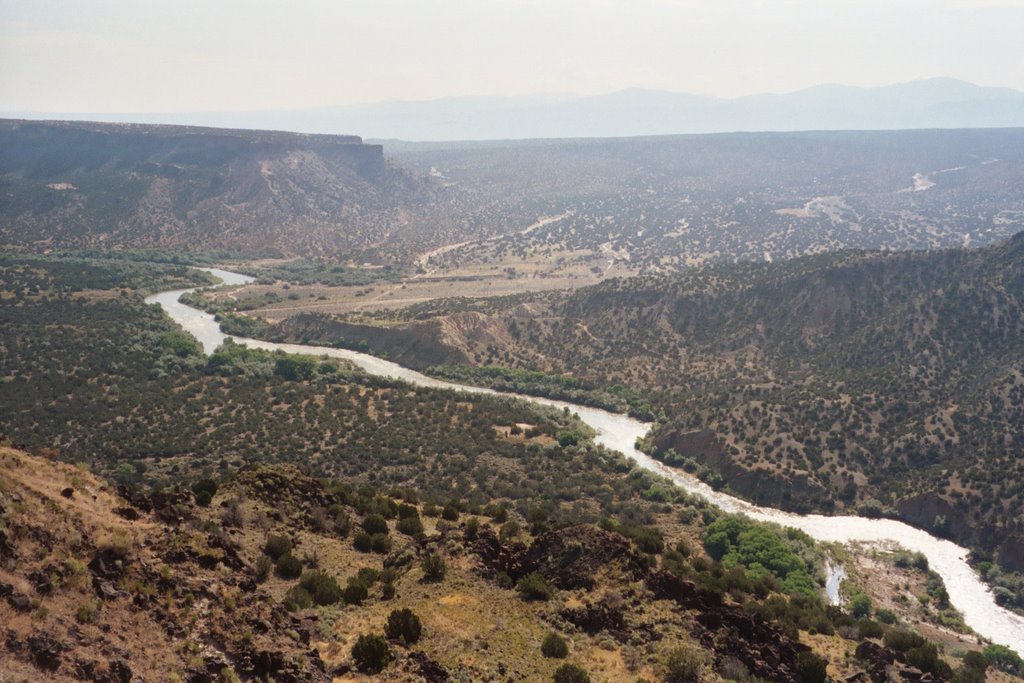 Most people, even those who have never studied the Latin language, recognize and know the meaning of the phrase tempus fugit -- "time flies." Popular culture has included the inseparable addage "when you're having fun" and so it remains.
Very few realize, though, that the original Latin phrase is tempus irreparabile fugit from Vergil's Sed fugit interea, fugit irreparabile tempus, singula dum capti circumvectamur amore (Georgics 3.284-5) and is much closer in meaning to Horace's carpe diem than the popular expression of surprise that the evening has passed while we were eating, drinking, and being merry.
Tempus irreparabile fugit essentially means "irrevocable time flies" or, better, "time flies and it's never coming back again." So... time does fly but not because you are having fun; rather, the reverse is true: you need to have fun because time flies.
The river in the picture is the Rio Grande winding its way through New Mexico. I took this photograph while playing hooky from the 2005 ACL Institute in Albuquerque.
Saturday, March 04, 2006
Zesty Zeugmata
I recently gave a diversionary assignment to my students in AP Latin in which they had to create original zeugmas. We made a contest out of it and voted for the best three, with the winners receiving candy. The zeugmas receiving the most votes were:
1) I hiked up my pants and the mountain. (TM)
2) Saying, "Der goes dem game," the redneck killed the deer and the English language. (TS)
3) Colby made a cake and Teiji's day. (TE)
For a more complete listing, check out http://www.riverbendlatin.com/.
1) I hiked up my pants and the mountain. (TM)
2) Saying, "Der goes dem game," the redneck killed the deer and the English language. (TS)
3) Colby made a cake and Teiji's day. (TE)
For a more complete listing, check out http://www.riverbendlatin.com/.
Thursday, March 02, 2006
Italy's Umbrella Pine

In his letter describing the eruption of Mt. Vesuvius, Pliny the Younger writes,
Nubes...oriebatur, cuius similitudinem et formam non alia magis arbor quam pinus expresserit. Nam longissimo velut trunco elata in altum quibusdam ramis diffundebatur, credo quia recenti spiritu evecta, dein senescente eo destituta aut etiam pondere suo victa in latitudinem vanescebat, candida interdum, interdum sordida et maculosa prout terram cineremve sustulerat. (Epistulae VI.16, ll. 13-18)
This passage immediately came to mind when I saw this perfect example of an umbrella pine tree in the ruins of Ostia Antica. I took this photograph in July 2005 with the intention of flashing it up on the wall from the digital projector whenever we read Pliny. Pictures are indeed worth a thousand words!
Class After AP
My students asked today what we were doing after the AP Latin Literature exam. Certainly they are not looking ahead and anticipating the end of the year... My reply was that we would be translating some of Horace's Odes. I had wanted to do the Catullus/Horace combination this year but a couple of very eager students convinced me that Ovid was the way to go. No problem on this end -- there was some things I wanted to do with the Amores anyway. In any case, I believe there are some poems of Horace that every serious Latin student must experience before graduating from high school. More about Horace later.
In the years that we have taken the AP Vergil exam, I often give my students a mini-lesson in ancient Greek. I have them learn to recite, read, and write the Greek alphabet, transliterate some Greek terms and roots into English, and then tackle the first few chapters from Crosby and Shaeffer's An Introduction to Greek and Balme and Lawall's Athenaze. The students enjoy this unique diversion and feel that they've gone back to first-year (which essentially they have) and that things are suddenly easy and exciting again. A few students have even gone on to take Greek in college. If nothing else, I tell my students that they can now go to college and identify the correct fraternity or sorority house advertised in the party flier.
In the years that we have taken the AP Vergil exam, I often give my students a mini-lesson in ancient Greek. I have them learn to recite, read, and write the Greek alphabet, transliterate some Greek terms and roots into English, and then tackle the first few chapters from Crosby and Shaeffer's An Introduction to Greek and Balme and Lawall's Athenaze. The students enjoy this unique diversion and feel that they've gone back to first-year (which essentially they have) and that things are suddenly easy and exciting again. A few students have even gone on to take Greek in college. If nothing else, I tell my students that they can now go to college and identify the correct fraternity or sorority house advertised in the party flier.
Subscribe to:
Posts (Atom)